Brown Hyena Facts: Africa’s Most Reclusive Hyena Species
Three hyena species live in Africa. Most safari visitors know the spotted hyena from game drives in Kenya and Tanzania. Few see the striped hyena. Almost no East Africa safari visitor encounters the brown hyena the most secretive and least studied of the three. The brown hyena occupies southern and southwestern Africa, with only marginal presence in East Africa’s drier zones. Understanding it requires leaving the Maasai Mara behind and thinking about an entirely different landscape and lifestyle.
What Is the Brown Hyena?
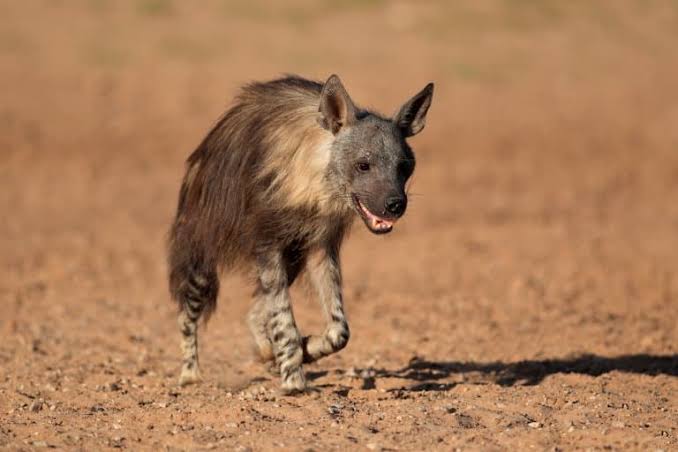
The brown hyena, Parahyaena brunnea, is the second-largest hyena species after the spotted hyena. An adult weighs between 37 and 55 kilograms. Body length reaches 1.1 to 1.4 metres. Shoulder height is about 70 to 80 centimetres. The coat is long, shaggy, and dark brown almost black along the back with a pale cream mane of longer hair on the neck and shoulders. The legs are horizontally striped in brown and white. The head is more rounded than the spotted hyena’s, with smaller ears and a less intimidating facial expression.
The mane is raised during threat displays and social encounters. The raising doubles the apparent height of the shoulders and neck, making the animal appear significantly larger than it is. A defensive brown hyena with its mane raised is one of the most visually impressive small predator displays in African wildlife.
Primarily a Scavenger
The brown hyena is primarily a scavenger more so than the spotted hyena, which kills most of what it eats. The brown hyena’s diet is dominated by carcasses found through smell across large home ranges. It also eats small mammals, birds, eggs, insects, and wild fruits. Its foraging style involves covering 30 to 50 kilometres per night across its home range, investigating every smell and sound that might indicate food. The long-legged walking gait is built for endurance rather than speed.
Brown hyenas find carcasses primarily through olfaction. The nasal sensitivity allows detection of a carcass from several kilometres under the right wind conditions. Following vultures is a secondary strategy a brown hyena that spots a vulture column descending will move toward the point for hours if necessary to investigate. This vulture-following behaviour is shared with the spotted hyena and with jackals.
Social Structure: The Clan With Individual Foraging
Brown hyenas live in clan groups of 4 to 14 individuals that share a communal territory. Clan members den together, raise cubs communally, and defend the territory collectively through scent marking. However, unlike the spotted hyena which frequently hunts and forages in groups, brown hyena clan members forage alone every night. The whole group occupies the same territory but does not move together. Each individual ranges independently, returns to the shared den or rendezvous point, and regurgitates food for cubs.
This combination of communal cub-rearing with individual foraging makes the brown hyena’s social system unique among the hyenas. The communal den is the social hub pups from different females are raised together and cared for by multiple adults. Male clan members carry food to the den for the pups. This cooperative pup-rearing by males is unusual in hyena society and appears to be genuinely beneficial to pup survival.
Range and East Africa Presence
The brown hyena’s core range is southern Africa the Kalahari, Namib desert margins, and the drier parts of South Africa. It extends into Zimbabwe, Mozambique, and northern Botswana. Its presence in East Africa is limited and marginal there are records from Tanzania’s central dry zones and from parts of Kenya’s dry northern border areas, but these are uncommon sightings at the species’ range edge. East Africa is not a practical destination for dedicated brown hyena watching.
The Kalahari Gemsbok National Park (Kgalagadi Transfrontier Park) in South Africa and Botswana is the most reliable brown hyena location in Africa. For East Africa visitors with a particular interest in this species, incorporating a southern Africa leg into the itinerary is the only reliable approach.
Plan Your Safari
Spotted hyenas remain the practical hyena-watching target in East Africa, with the Ngorongoro Crater and Maasai Mara delivering the continent’s best hyena clan encounters. For visitors determined to see all three African hyena species, a combination East Africa and southern Africa safari is the approach East Africa for spotted hyenas, Kgalagadi for brown hyenas, and the Serengeti-Mara border regions for the occasional striped hyena on night drives.
African Wild Trekkers designs multi-country African safaris for wildlife enthusiasts targeting specific species. Contact us to plan a comprehensive African predator safari that covers the continent’s full hyena diversity.