Ethiopian Wolf Facts: Africa’s Rarest Carnivore
The Ethiopian wolf is Africa’s most endangered carnivore. Fewer than 500 individuals survive on the high Afroalpine plateaus of Ethiopia. It is the world’s rarest wild canid. It hunts alone but lives in packs. It eats rodents that weigh a fraction of its own body weight. And it lives at altitudes above 3,000 metres where almost no other large predator can persist. The Ethiopian wolf is simultaneously remarkable, fragile, and entirely dependent on the continued management of a handful of Ethiopian mountain ecosystems.
What Is the Ethiopian Wolf?
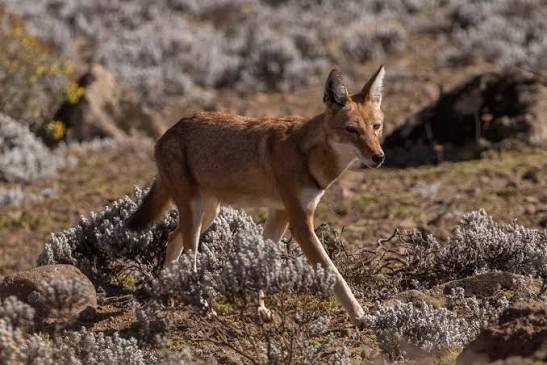
The Ethiopian wolf, Canis simensis, belongs to the genus Canis — the same genus as wolves, dogs, jackals, and coyotes. Despite its name and superficial appearance, it is not closely related to grey wolves. Genetic analysis places it closest to the ancestors of domestic dogs among African canids. An adult weighs between 11 and 19 kilograms. Body length reaches 84 to 101 centimetres. The coat is a vivid russet-red above with a white throat, chest, and inner leg. The long muzzle and long legs give it a rangy, elegant appearance quite different from sub-Saharan Africa’s jackal species.
The red-and-white colouration is distinctive at any distance. In the open, yellow-green grassland of the Afroalpine plateau, an Ethiopian wolf is visible from several hundred metres. The colour contrast appears to function both in intraspecific communication — pack members locate each other across the open plateau — and as a territorial signal to adjacent packs.
The Afroalpine Habitat: Why So High?
Ethiopian wolves live exclusively in Afroalpine habitat above 3,000 metres. The Afroalpine zone — open moorland and grassland above the tree line — covers only a small fraction of Ethiopia’s land area. The Bale Mountains National Park holds the largest population, with approximately 250 wolves in the Sanetti Plateau and the Web Valley. Smaller populations survive on the Simien Mountains, the Arsi highlands, and several other isolated mountain massifs.
The altitude specialisation reflects a food specialisation. The Afroalpine zone’s rodent community — dominated by giant mole rats, grass rats, and montane mice — is extraordinarily dense. Rodent burrow densities on the Sanetti Plateau reach levels that provide a consistently reliable prey base for a solitary-foraging hunter. No lower-altitude habitat in Ethiopia provides comparable rodent prey density for an animal of the Ethiopian wolf’s size.
Hunting Rodents: The Solitary Specialist
Ethiopian wolves hunt alone for rodents despite living in social packs. The typical hunt involves slow, patient stalking across the moorland, pausing and listening near mole rat burrow mounds, then pinning the emerging rodent with both forepaws in a rapid pounce. Giant mole rats — which weigh up to 900 grams — require a specific extraction technique when partially underground: the wolf bites the mole rat as it emerges and holds on while the rodent digs backward in an attempt to re-enter the burrow. The wolf braces and pulls until the mole rat comes free.
A single Ethiopian wolf catches multiple rodents per day during peak activity periods. The caloric content of the small prey requires high catch rates to maintain body condition. Adult wolves spend 6 to 8 hours per day in active hunting during the coolest parts of the day — early morning and late afternoon when the rodents are most active at the surface.
Pack Structure and Territory
Ethiopian wolves live in packs of 3 to 13 individuals. A dominant female breeds and all pack members contribute to pup-rearing — feeding pups by regurgitation and guarding the den site. This cooperative breeding system is essential in the Ethiopian wolf’s habitat, where pup mortality from disease, predation, and exposure is high.
Pack territories are actively defended against adjacent packs through scent marking, calling, and group displays at territorial boundaries. The pack’s collective defence of a territory ensures that each member has exclusive access to the territory’s rodent prey during the crucial pup-rearing period.
Conservation: Disease, Hybridisation, and Habitat
Rabies and distemper outbreaks have killed significant fractions of Ethiopian wolf populations in epidemic years. The 2010 rabies outbreak in the Bale Mountains killed approximately 70 wolves — about 30 percent of that population. Vaccination programmes for domestic dogs in surrounding communities have reduced the disease transmission risk. Hybridisation with domestic dogs is also a concern — hybrid offspring are non-viable long-term but hybridisation reduces the proportion of genetically pure wolves.
Plan Your Safari
The Bale Mountains National Park in southern Ethiopia is the only practical location to see Ethiopian wolves. The Sanetti Plateau — accessible by four-wheel drive from the park headquarters — produces daily sightings of hunting wolves during the early morning hours. This is a specialist destination that requires a dedicated Ethiopia itinerary rather than a regional East Africa circuit.
African Wild Trekkers designs Ethiopia wildlife itineraries that combine Ethiopian wolf watching in the Bale Mountains with the country’s other extraordinary wildlife and cultural experiences. Contact us to plan an Ethiopia safari around Africa’s rarest and most extraordinary canid.