Leopard Nocturnal Hunting: How Africa’s Most Skilled Cat Hunts After Dark
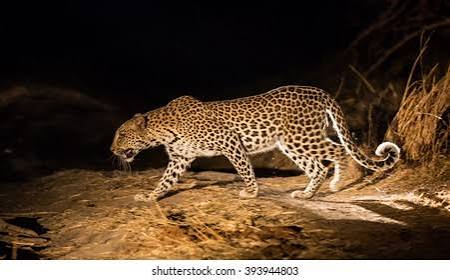
The leopard is the most accomplished nocturnal predator in East Africa. Lions hunt predominantly by sight and rely on group coordination in twilight. The leopard hunts alone, in complete darkness, using forward-facing eyes with reflective tapetum lucidum, acute hearing, and a physical capacity for silence that no other large carnivore matches. It kills prey ten times its own weight. Dense bush does not slow it. And it accomplishes all of this in darkness effectively opaque to the unaided human eye. Nocturnal leopard hunting operates in a sensory and physical world that human observers can barely imagine.
The Night Vision Anatomy
The leopard’s eyes achieve low-light performance far beyond any human visual system. The retina packs an extremely high density of rod photoreceptors the cells responsible for low-light monochrome vision. The pupil dilates to maximum diameter in darkness, admitting as much light as possible. Behind the retina, the tapetum lucidum bounces light back through the photoreceptors a second time, effectively doubling available light. That reflection produces the characteristic eye-shine when a spotlight illuminates a leopard at night.
In moonlight, a leopard sees as clearly as a human in bright sunshine. On a dark cloudy night — not quite zero light — vision remains functional. Only in absolute zero-light conditions does the leopard shift to hunting primarily by hearing.
The Silence of Approach
A leopard approaching prey at night produces almost no sound. Soft pads land on the outer edge first and roll inward minimising impact noise. Fully retracted claws never touch the ground during stalking. Body weight distributes across three or four contact points simultaneously as the leopard moves forward. The tail stays low and still. The head carries close to the ground, reducing the profile against the skyline.
Cover drives every step of the approach. Shadows, grass clumps, and terrain depressions all break the visual silhouette in turn. Prey at night relies primarily on hearing rather than sight. Silent movement brings the leopard within 5 to 10 metres before the final rush. The prey detects the rush by sound — a millisecond before impact.
Kill and Hoist: The Night’s Work
The kill is fast a throat grip placed with precise jaw positioning within the first second of contact. After the kill, the leopard assesses the area for competitors. Hyenas are the primary threat to a kill left on the ground. Lions are the secondary threat. Hoisting a kill into a tree is the direct response to steal probability in any given location. In the Maasai Mara, where hyena density is high, leopards hoist almost every kill made in the open. In lower-density areas, kills sometimes stay on the ground.
Hoisting a prey animal heavier than itself requires neck and jaw muscles doing extraordinary work. The leopard grips the dead animal by the throat or neck, backs toward the tree, finds a trunk fork with its hindlegs, then walks backward up the trunk carrying the body. This manoeuvre has appeared on film hundreds of times and remains astonishing on each viewing.
Night Drives and Leopard Observation
Night drives in areas with well-habituated leopards produce the most intimate nocturnal encounters available. Leopards that accept vehicles as non-threats allow close approach in darkness and continue hunting naturally beside a quiet, engine-off vehicle. This habituation level is rare it exists only where specific locations have maintained careful, respectful night drive management over many years.
Plan Your Safari
Tanzania’s Nyerere National Park, Kenya’s Laikipia conservancies, and the Maasai Mara produce the best nocturnal leopard encounters in East Africa. Night drives departing at 7 to 8 pm, with experienced spotters working handheld lights, are the standard approach. South Luangwa National Park in Zambia is the finest nocturnal leopard location in Africa worth considering for visitors willing to extend beyond East Africa for the definitive leopard night drive experience.
African Wild Trekkers selects accommodations with excellent night drive programmes for leopard-focused visitors. Contact us to plan a safari that puts you with hunting leopards after dark.