Cheetah Mother and Cubs: Raising the Most Vulnerable Cubs in Africa
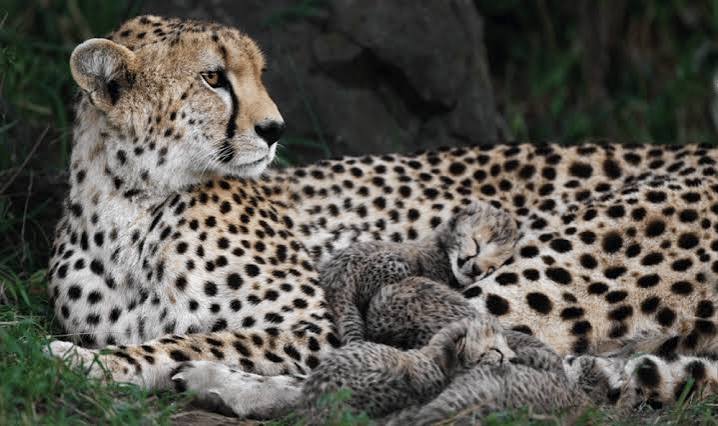
A cheetah mother raising cubs faces a combination of problems no other African predator deals with simultaneously. She hunts alone and must eat quickly before competitors steal the kill. She hides cubs too young to move while she hunts. She teaches rapidly growing cubs using prey she cannot safely hold for extended lessons. Through all of this, she avoids lions, leopards, and hyenas that will kill her cubs on discovery. Cub survival to independence averages around five months out of a twelve-month period. In lion-dense areas, the figure drops lower.
The First Two Months: Hiding the Cubs
Cheetah cubs arrive in a secluded lair a dense bush clump, a rocky outcrop, or a drainage ditch in tall grass. A litter averages 3 to 5 cubs. Newborns weigh approximately 250 to 300 grams. The coat is grey-blue with a distinctive dorsal mantle of long, pale hair running from the back of the head to the rump. This mantle fades over the first few months of life.
The grey dorsal mantle’s function has generated decades of debate. The most widely accepted hypothesis links it to honey badger mimicry one of Africa’s most notoriously aggressive and difficult-to-kill small mammals. The resemblance may discourage some predators from approaching cubs they might otherwise target.
In the first two months, the mother moves the cubs regularly sometimes daily reducing the chance a predator locates them by following her scent trail or searching systematically. She leads or carries cubs individually to each new site, returning multiple times for larger litters. Cubs rest hidden while she hunts, sometimes alone for 12 to 16 hours.
Cubs Begin to Follow: Three to Six Months
From approximately 6 weeks old, cubs begin accompanying the mother on short movements. From 2 to 3 months, they follow her on hunts consistently. At this stage they do not join the hunt directly. They watch from 30 to 50 metres behind during the stalking approach. Their presence compromises success movement and curiosity from the cubs alert prey before the mother closes to ambush range, pushing her success rate below her solo average.
Hunting technique transfers through observation. Cubs watch the stalk, the sprint, and the suffocation grip repeatedly. The mother provides practice opportunities on immobilised or injured prey releasing a live Thomson’s gazelle fawn for the cubs to chase, intervening to prevent escape if they lose it, then allowing the chase to resume. This play-hunting with partially constrained prey is the primary transfer of hunting skill, documented across mother-cub groups in the Maasai Mara and Serengeti.
Cub Independence: The Hardest Phase
Cubs reach independence at 15 to 17 months. The mother separates from her offspring once they hunt capably. The newly independent siblings males and females together initially remain as a group for 6 to 8 months after the mother’s departure. This sibling group then splits as females disperse into independent ranges and males form stable coalitions that will persist for life.
Post-independence carries the highest mortality risk outside the cub period itself. Young cheetahs lack the experience in precise prey selection, terrain use, and competitor avoidance that adults manage intuitively. The hunting errors and territorial risks taken in this phase get young cheetahs killed by lions and hyenas more than any other single cause.
Plan Your Safari
The Maasai Mara conservancies particularly Naboisho and Mara North produce the most reliable cheetah family group sightings in East Africa. Open grass plains allow following a mother and cubs over several kilometres of movement, observing teaching hunts and cub-mother interplay at close range from a vehicle. Single-day visits produce encounters. Multi-day stays in the right conservancy produce understanding.
African Wild Trekkers monitors cheetah family groups in the Maasai Mara conservancies and builds itineraries around current locations. Contact us to plan a Kenya safari timed to cheetah family activity.