Mountain Reedbuck Facts: The Rocky Highland Antelope of East Africa’s Escarpments
The mountain reedbuck occupies a completely different ecological space from the bohor reedbuck of East Africa’s lowland floodplains. The bohor reedbuck needs tall grass and permanent water. The mountain reedbuck lives on rocky hillsides, steep escarpment slopes, and short-grass montane grassland in East Africa’s highland zones. Smaller than the bohor, with differently shaped horns and physiological adaptations to altitude, this antelope has made a living in terrain that excludes most of its relatives.
What Is a Mountain Reedbuck?
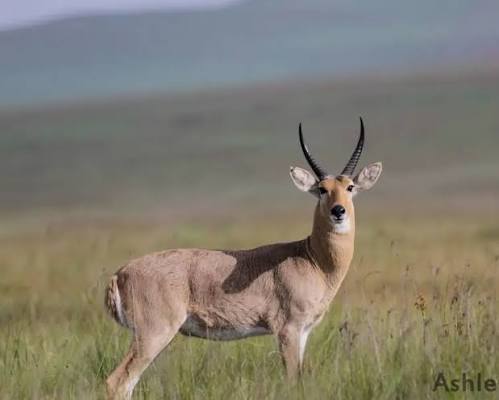
The mountain reedbuck, Redunca fulvorufula, is the smallest of the three reedbuck species. Adult males weigh between 25 and 38 kilograms. Females weigh 23 to 30 kilograms. Shoulder height reaches 65 to 76 centimetres. Only males carry horns distinctively forward-curved near the tip, reaching 14 to 38 centimetres. These horns are shorter and more strongly hooked than the bohor reedbuck’s less curved horns. The coat is a uniform pale fawn-grey, slightly paler than the bohor’s more reddish-brown colouring. The forehead is distinctly grey. A subauricular gland patch sits below each ear, smaller than the bohor’s version.
Mountain reedbucks share the bohor’s rocking, stiff-legged canter when alarmed, and produce the same sharp whistle alarm call when flushed from concealment. The whistle carries well across open rocky terrain.
Rocky Highland Habitat
The mountain reedbuck prefers rocky hillsides with short grass and scattered brush on steep slopes at altitudes of 1,500 to 3,000 metres. Rocky terrain provides its escape route when threatened, the mountain reedbuck flees uphill into broken rocky ground. Agility on steep, irregular surfaces outmanoeuvres most predators that cannot maintain speed on rocks. This strategy parallels the klipspringer’s rocky terrain use, though the mountain reedbuck is less extreme a specialist and uses the grass as its primary feeding terrain.
Kenya’s Aberdare Mountains, Mount Kenya’s lower slopes, the Rift Valley’s escarpment margins, and the Laikipia Plateau’s rocky hills all hold populations. In Tanzania, the highlands around the Ngorongoro rim and the Mbulu Plateau support mountain reedbucks. Ethiopia’s montane grasslands produce the most accessible encounters in the region.
Social Structure and Seasonality
Mountain reedbucks live in pairs and small family units rather than the larger herds of lowland antelope. A territorial male holds a rocky hillside territory and maintains a stable association with a female or a small group of females. Territories are relatively small 20 to 50 hectares because rocky habitat provides feeding and escape terrain within a compact area. Mountain reedbucks are more sedentary than most savanna antelope. Their territory covers all essential resources. Movement stays concentrated within a familiar landscape the animal knows in detail. Once an individual or pair is located, repeated sightings from the same observation point are predictable.
Plan Your Safari
Kenya’s Aberdare National Park is the most accessible East Africa location for mountain reedbuck. The Aberdares’ montane grassland and rocky moorland above the forest zone holds a resident population. Moorland drives and walks on the plateau produce regular sightings. The Rift Valley escarpments visible from Lake Nakuru National Park’s rocky margins also carry mountain reedbuck. Ethiopia’s Bale Mountains combine mountain reedbuck with Ethiopian wolves and extraordinary Afroalpine scenery one of the finest highland wildlife experiences in East Africa.
African Wild Trekkers includes the Aberdares and the Rift Valley escarpments in Kenya highland safari itineraries. Contact us to plan a safari that captures Kenya’s highland wildlife alongside the savanna’s big game.