Slender Mongoose Africa: The Fast Solitary Hunter of East Africa’s Open Country
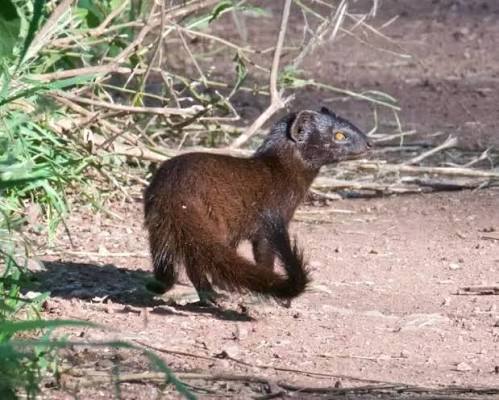
The slender mongoose is the most commonly encountered solitary mongoose species on East Africa game drives. Small under 700 grams fast, and diurnal, it is visible to any alert passenger scanning the roadside on a morning drive. A distinctive black tip marks its long tail, held upright when running — a flag-like signal flickering above the grass. That tip identifies the species immediately even when the body is concealed. Understanding the slender mongoose means looking carefully at the small, fast mammals that most game drive passengers miss entirely.
What Is a Slender Mongoose?
The slender mongoose, Herpestes sanguineus, is one of the most widespread small carnivores in Africa. Adults weigh between 350 and 700 grams. Body length reaches 23 to 36 centimetres with a proportionally long tail of 18 to 30 centimetres. The coat varies from pale sandy-brown in dry-country populations to rich reddish-brown in wetter zones. The black tail tip is constant across all colour variants. When the tail raises during movement, the black tip stands out at 40 to 50 metres.
The body is elongated and flexible. The slender mongoose moves with a fluid, undulating gait reminiscent of a weasel rather than the stiffer movement of larger mongoose species. This flexibility lets it pursue prey into rodent burrows and rock crevices that the broader bodies of other mongooses cannot enter.
Diurnal and Solitary
The slender mongoose is primarily diurnal active from dawn to dusk with a midday rest during the hottest hours. Foraging is solitary across a home range of 0.5 to 1.5 square kilometres, depending on habitat productivity. Males maintain larger ranges than females, overlapping with the ranges of several females. Males range widely to locate receptive females, advertising presence through scent marks rather than through direct territorial exclusion of rivals.
The diurnal, solitary habit contrasts with the banded and dwarf mongooses’ social, cooperative foraging. Body size explains the difference. A 500-gram solitary forager finds sufficient invertebrate prey in woodland habitat for its own caloric needs without sharing. A 200-gram dwarf mongoose cannot — it needs collective foraging effort and group predator vigilance to survive.
Prey and the Black Tail Tip Signal
The slender mongoose eats invertebrates, small rodents, lizards, frogs, eggs, and occasionally small birds. A rapid pounce captures insect prey the mongoose detects movement or sound in leaf litter and strikes before the prey can move. Rodents draw pursuit into burrows when possible. Venom immunity allows it to take small to medium venomous snakes when encountered.
The black tail tip held vertical during movement is probably a social signal. It identifies the species to other slender mongooses with overlapping territories. Upright display may also deter small hawks that might otherwise mistake the running mongoose for a suitable target the conspicuous raised tip is far more visible from above, from a hawk’s angle, than from the side.
Plan Your Safari
Slender mongooses are present throughout East Africa’s savanna, open woodland, and rocky country. Early morning game drives produce the most sightings before the midday heat drives them to shade. Rocky areas and termite-mound zones in the Maasai Mara woodland, Samburu, Tarangire, and Serengeti all deliver sightings regularly. Scan the roadside vegetation at low level — the slender mongoose moves fast but pauses frequently to investigate smells, producing the brief stillness that allows identification.
African Wild Trekkers designs East Africa safaris that pay attention to smaller mammals alongside the large. Contact us to plan an itinerary that captures the full diversity of East Africa’s extraordinary wildlife.