Greater Kudu Facts Africa: The Spiral-Horned Ghost of East Africa’s Bush
The greater kudu carries the most spectacular horns of any African antelope. A mature bull’s horns spiral through two and a half to three complete turns and reach up to 180 centimetres along the outer curve. Yet the kudu’s most remarkable quality is not the horns it is the ability to disappear. A bull kudu standing in dappled thornbush is almost invisible despite its size. The pale vertical body stripes against grey-brown coat, the dark face markings, and the natural stillness of a kudu alert all render a 300-kilogram animal effectively invisible from 30 metres in moderate bush cover. Safari guides call it the grey ghost of the bush for good reason.
What Is a Greater Kudu?
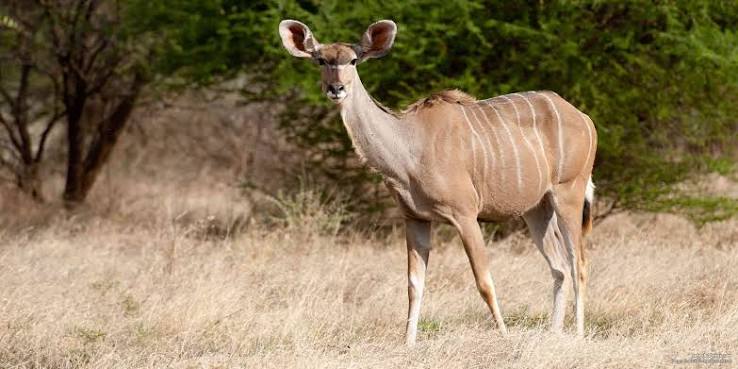
The greater kudu, Tragelaphus strepsiceros, is the second largest African antelope after the eland. Adult bulls weigh between 190 and 315 kilograms. Cows weigh 120 to 215 kilograms. Shoulder height in bulls reaches 1.4 metres. Only males carry horns the spectacular open, spreading spiral that grows through 2.5 to 3 complete turns in mature bulls, reaching 100 to 180 centimetres in length. The coat is grey-brown with 6 to 10 narrow white vertical stripes on the flanks. A white chevron between the eyes and white cheek spots mark the face. A short, erect mane runs from the back of the head to the base of the tail.
Females are hornless and more uniformly reddish-brown than males, with the same white striping. The sexes differ markedly enough in appearance that first-time observers sometimes treat them as different species.
The Camouflage: How a Large Animal Disappears
The greater kudu’s camouflage works through disruptive patterning. White vertical stripes on the flanks break up the body outline against vertical stems, grass stalks, and mottled bush shadow. Grey-brown base colour matches the colour of dry thornbush bark and shadow. White face markings and dark forehead create facial disruptive patterning that breaks the eye line. Combined with a kudu’s natural behaviour when alarmed standing motionless, orientating the head toward the observer, and freezing rather than running the camouflage renders it almost impossible to detect against a bush background.
Browsing Diet and Dense Bush Preference
Greater kudu are browsers almost exclusively. Leaves, shoots, seedpods, wild fruits, tubers, and bark dominate the diet. This browsing specialisation drives the habitat preference dense thornbush, riverine woodland, rocky hillside scrub, and the margins of miombo woodland all deliver the browse diversity that kudu require. Open grassland holds nothing for a kudu. The densest bush on any game drive route is where guides search for kudu and rarely fail.
Range in East Africa
Greater kudu are widespread in Tanzania Ruaha, Selous-Nyerere, Katavi, and the Rift Valley woodland zones all hold populations. Kenya’s dryer woodland zones Tsavo West, the Rift Valley escarpment woodland, and the Aberdare foothills carry smaller populations. Uganda holds kudu only in marginal dry-country zones in the north. Ethiopia’s woodland areas hold populations. In all cases, dense thornbush and woodland rather than open grassland is where they live.
Plan Your Safari
Tanzania’s Ruaha National Park and Selous-Nyerere Game Reserve are the finest East Africa kudu destinations. Ruaha’s dense Acacia-Combretum woodland produces daily kudu encounters sometimes very large bull groups at the Ruaha River’s rocky margins. Selous-Nyerere’s riverine forest and dense thicket hold kudu in numbers that make walkable, slow-vehicle exploration through the thick bush the most productive approach. Kenya’s Tsavo West rocky areas deliver kudu sightings for visitors on the southern Kenya circuit.
African Wild Trekkers designs Tanzania safari itineraries with Ruaha and Selous-Nyerere as key components for visitors wanting to encounter the full range of Tanzania’s extraordinary antelope diversity. Contact us to plan a safari that goes beyond the Serengeti.