Steenbok Facts: The Tiny Solitary Antelope of East Africa’s Open Plains
The steenbok is one of East Africa’s smallest antelopes and one of the hardest to see well. Small size, cryptic colouration, and a preference for freezing motionless before fleeing combine to make it the master of going unnoticed on open plains. Yet steenboks are present on almost every East Africa game drive in suitable habitat — the difficulty lies in distinguishing the small russet form pressed flat in short grass from the grass itself. When a steenbok does flee, it sprints in a series of sharp zigzag turns before dropping flat again in the next available concealment, often only 30 metres from the original position.
What Is a Steenbok?
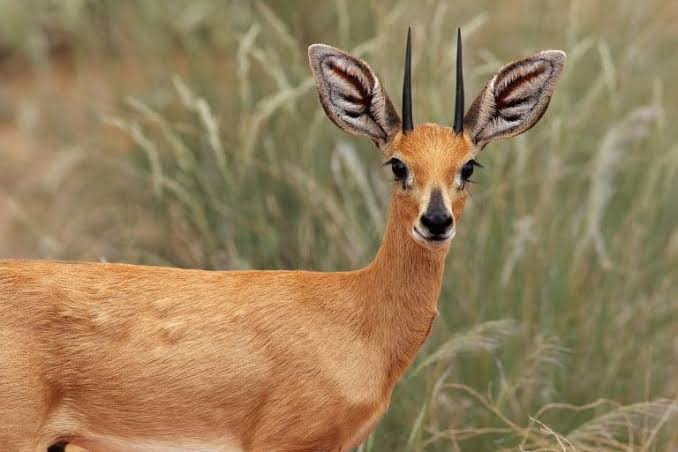
The steenbok, Raphicerus campestris, is a small antelope. Adults weigh between 7 and 16 kilograms. Shoulder height reaches 45 to 60 centimetres. Only males carry horns — short, straight, and slightly forward-angled, reaching 7 to 19 centimetres. The coat is rich rufous-orange on the back and sides with white underparts. The face carries a distinctive white ring around each large dark eye and white inner ear surfaces that contrast sharply with the rufous coat. The nose is black. Large, wide-set ears rotate independently while the animal stands alert. No visible tail is apparent in the field — the tail is very short and usually held flat.
Solitary and Territorial
Steenboks are solitary. A male and female share overlapping territories but rarely move together — the pair meets primarily during the female’s oestrus period. Each individual marks its territory with preorbital gland secretion on twigs and grass stems and deposits dung in small scrapes that it covers with soil afterward — concealing the dung to avoid advertising its presence to predators. This dung burial behaviour is unusual among small antelopes and reflects the steenbok’s vulnerability to a wide range of predators including servals, caracals, African wild cats, martial eagles, and pythons.
Dietary Flexibility: Digging for Food
Steenboks eat leaves, buds, fruit, berries, bark, and occasionally grass. Their most distinctive feeding behaviour involves digging. Steenboks use their hooves to excavate roots, tubers, and bulbs from the soil — a feeding resource that most small antelopes cannot access. This dietary flexibility becomes critical during dry seasons when surface vegetation quality declines sharply. Water independence is complete — steenboks extract sufficient moisture from roots, succulent plant parts, and the leaves they consume, allowing year-round residency in arid habitats with no surface water.
Freeze, Flush, and Flee: Predator Evasion
A steenbok detecting a predator at distance freezes immediately. It lowers the body close to the ground and holds absolutely still, relying on its rufous coat to blend with dry grass. This freeze strategy works against visually-hunting predators like hawks at long range. At close approach, the steenbok flushes suddenly — exploding from concealment at full speed, zigzagging sharply to break a pursuing predator’s line, then dropping flat again in new cover. This run-and-hide cycle can repeat multiple times before the predator abandons the pursuit.
Range in East Africa
Steenboks occur across Kenya’s open plains and dry-country savanna — Tsavo, Amboseli, the Laikipia Plateau, and the Rift Valley all hold populations. Tanzania’s Serengeti, Tarangire, and southern wildlife management areas carry steenboks in open grassland and scrub. They do not appear in Uganda’s wetter forest-margin habitats.
Plan Your Safari
Amboseli, Tsavo East, and Tarangire produce the most reliable steenbok encounters in East Africa. Short open grass with minimal tall vegetation is the key habitat indicator. Dawn drives in dry country — when steenboks are most actively feeding before the heat of the day — give the best observation conditions. Stopping the vehicle when a small rufous shape appears at the roadside and waiting quietly for the freeze posture to relax allows observation of the full range of steenbok behaviour at close range.
African Wild Trekkers designs Kenya and Tanzania dry-country safari itineraries that reveal the full range of small antelope diversity alongside the major wildlife spectacles. Contact us to plan a safari that gives these remarkable small animals the attention they deserve.