Grevy’s Zebra Facts: The Endangered Giant Zebra of Kenya’s Northern Drylands
The Grevy’s zebra is the world’s largest wild equid and one of the most endangered large mammals in Africa. Fewer than 3,000 individuals survive, concentrated almost entirely in northern Kenya with a small population in southern Ethiopia. This species differs from the plains zebra in nearly every important characteristic — size, stripe pattern, social system, habitat preference, and conservation status. Seeing a Grevy’s zebra in the dry acacia scrub of Samburu is one of Kenya’s genuinely rare wildlife experiences.
What Is a Grevy’s Zebra?
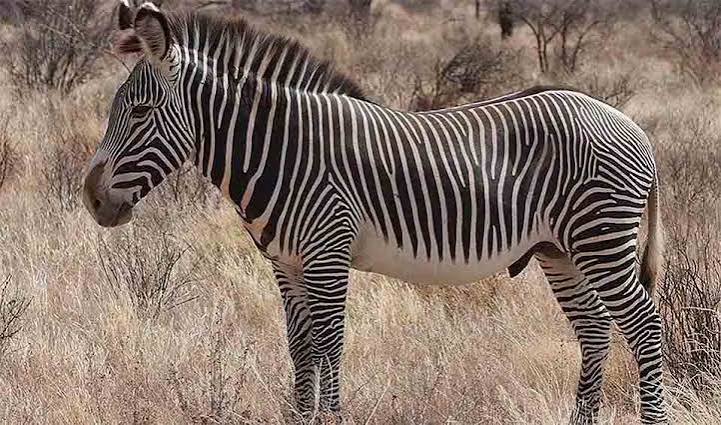
The Grevy’s zebra, Equus grevyi, is the largest of the three African zebra species. Adults weigh between 350 and 450 kilograms. Shoulder height reaches 1.4 to 1.6 metres. The stripe pattern is immediately distinctive — very narrow, closely spaced black stripes on a white ground cover the entire body. A broad black stripe runs down the spine, and the belly and inner thighs are white and unstriped. The ears are very large, rounded, and mule-like — far larger than those of the plains or mountain zebra. The muzzle is broad and rounded with a distinctly convex profile when viewed in profile. These features together make the Grevy’s zebra unmistakable beside the plains zebra in the field.
Stallion Territories: A Different Social System
Grevy’s zebra social structure differs completely from the plains zebra’s family unit system. Adult Grevy’s stallions hold large exclusive territories of 2 to 12 square kilometres in areas with reliable water. These territories are the largest held by any herbivore in Africa. The stallion defends his territory against rival males through patrol, vocalisation, and fighting when necessary. Females move freely between territories, following water and grazing quality. A female in oestrus on a stallion’s territory mates with that territory’s owner. No permanent bond forms between the stallion and the mares he mates with.
This territory-based mating system means females have complete freedom of movement based on resource quality. During the dry season, mares with foals concentrate around permanent water sources — often within a single stallion’s territory — while males without permanent water access travel more widely. Sub-adult males form bachelor groups and roam outside territorial areas until old enough to compete for a territory.
Endangered Status and Threats
Grevy’s zebra populations declined from approximately 15,000 in the 1970s to under 3,000 today. Habitat loss through conversion of dry-country rangeland to smallholder agriculture reduced available territory. Competition with livestock for water and grazing further stressed populations. Hunting in Ethiopia and Kenya during the 1970s and 1980s took significant numbers before legal protection took effect. Current threats centre on water competition with livestock, drought impacts on foal survival, and habitat fragmentation across the Kenya-Ethiopia border landscape. The Grevy’s Zebra Trust, operating across northern Kenya, coordinates community-based monitoring and conservation programmes.
Range and Habitat
Grevy’s zebras occupy arid and semi-arid grassland and acacia scrub in northern Kenya and southern Ethiopia. Samburu, Buffalo Springs, and Shaba National Reserves hold Kenya’s most reliable Grevy’s zebra populations. Laikipia’s northern reaches carry additional individuals during wet-season dispersal. The species requires permanent water within its territory system — completely waterless terrain cannot support stallion territory establishment. Grevy’s zebras drink daily in hot conditions and can travel long distances to reach water during drought.
Plan Your Safari
Samburu National Reserve is the premier East Africa destination for Grevy’s zebra. The reserve holds resident populations visible on nearly every game drive along the Ewaso Nyiro River. The contrast between Grevy’s zebras and plains zebras — often visible together at the same water points — makes stripe-pattern comparison straightforward in the field. Laikipia Plateau conservancies such as Ol Pejeta and Lewa add Grevy’s zebra encounters to a northern Kenya circuit alongside white rhino, reticulated giraffe, and gerenuk.
African Wild Trekkers designs northern Kenya safari circuits that combine Samburu’s extraordinary dry-country wildlife with Laikipia’s conservancy experiences. Contact us to plan a Kenya itinerary that includes the Grevy’s zebra alongside the north’s other unique mammal species.