Amethyst Sunbird: East Africa’s Darkest and Most Striking Forest Sunbird
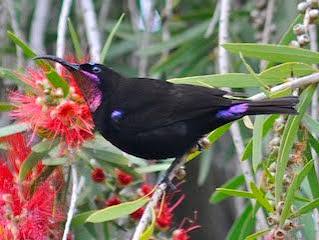
The amethyst sunbird stands apart from East Africa’s many brilliantly coloured sunbird species through a dramatically different approach to plumage. The male is almost entirely black, with an amethyst-purple throat patch and a green iridescent crown that flash with colour when the light catches them at the right angle. Against the surrounding vegetation, this dark bird with its hidden iridescence is one of the most distinctive and memorable sunbird encounters in East Africa’s forest and woodland environments.
The species is also known as the black sunbird in several field guide references, though this name causes some confusion with related species in West Africa. The amethyst sunbird is the most widely distributed of the predominantly black sunbird species in East Africa and is reliably encountered in its forest edge and woodland habitats throughout the region.
Identification
The male amethyst sunbird appears black from a distance. At closer range, the throat shows a vivid amethyst-purple iridescence. The crown shows a metallic green gloss. The rest of the plumage is sooty black without iridescence. The bill is long, curved, and black. The overall silhouette and the dark plumage immediately distinguish the male from all other East African sunbirds at a glance.
The female is olive-brown above and pale yellow with dark streaking below. The pale yellow supercilium is a useful feature for identifying female amethyst sunbirds. The streaked underparts distinguish her from the plain underparts of several related female sunbirds with similar olive-brown upperparts.
The call is a series of loud, penetrating “tseep” notes more carrying than most other sunbird species. The call identifies the species well before the bird comes into view and allows tracking of individuals moving through dense vegetation. The male’s song is a series of musical, varied phrases delivered from exposed perches above the territory.
Habitat and Diet
The amethyst sunbird inhabits forest edges, dense woodland, coastal scrub, and well-wooded garden environments. It is less dependent on high-altitude habitat than the malachite sunbird and occurs from near sea level to approximately 2,000 metres across its East African range. This altitude flexibility makes it accessible on a wider range of safari destinations than the strictly montane sunbird species.
The species feeds on nectar from a range of flowering trees and shrubs. It is particularly attracted to the flowers of Erythrina coral trees, Acacia species, and various introduced flowering garden plants. The male defends productive flowering trees with persistent calling and aggressive chasing of competing sunbirds.
Additionally, the amethyst sunbird takes insects as a significant dietary supplement. It hawks flying insects from exposed perches and searches leaf surfaces for small invertebrates during slower foraging bouts. This insectivory is most pronounced during the breeding season when protein-rich food is most critical for successful chick rearing.
Where to See Amethyst Sunbirds in East Africa
The amethyst sunbird is common throughout East Africa in suitable forest edge and woodland habitats. Kenya’s coastal forest zone from Mombasa southward provides dense amethyst sunbird populations in the coastal scrub and forest edge along the Kenya coast and the Tanzania border zone.
Uganda’s forest edges throughout the south and west, including the margins of Kibale, Budongo, and Bwindi forests, carry good amethyst sunbird populations. The species is regularly encountered during chimp trekking walks on the forest tracks at these sites.
Tanzania’s Eastern Arc forests, the woodland areas around Arusha, and the coastal forest strip from Tanga southward all hold amethyst sunbird populations. Any birding walk through East Africa’s denser woodland and forest edge habitats will encounter this striking dark sunbird.
Plan Your Birding Safari
Amethyst sunbird sightings are most reliably achieved at East Africa’s forest edge and coastal scrub destinations. The species requires no specialist access and appears regularly in lodge gardens at forest and coastal destinations throughout the region.
The male’s dark plumage is best appreciated at close range in direct sunlight when the amethyst and green iridescent elements become fully visible. Morning garden birding at a coastal Kenya or forest Uganda lodge reliably produces close encounters with displaying males.
African Wild Trekkers includes forest edge and coastal destinations in East Africa birding safari itineraries where sunbird diversity is broadest. Contact us to plan a safari that captures East Africa’s full range of sunbird species from the garden visitors to the highland mountain specialists.