Red-footed Falcon: Europe’s Falcon That Migrates to East Africa Each Winter
The red-footed falcon is a small, insectivorous falcon that breeds in eastern Europe and central Asia and migrates to sub-Saharan Africa for the northern winter. Enormous flocks of hundreds to thousands of individuals cross East Africa during the October to November and March to April migration windows. The species arrives in East Africa in numbers that make it one of the most abundant migrant raptors in the region during peak passage events.
The red-footed falcon is a highly gregarious species that roosts communally in large trees and hunts in loose flocks over grassland and savanna. The sight of dozens or hundreds of small falcons perched together in a single tree or hovering over a grasshopper-rich grassland is one of East Africa’s most extraordinary raptor spectacles during the right season.
Identification
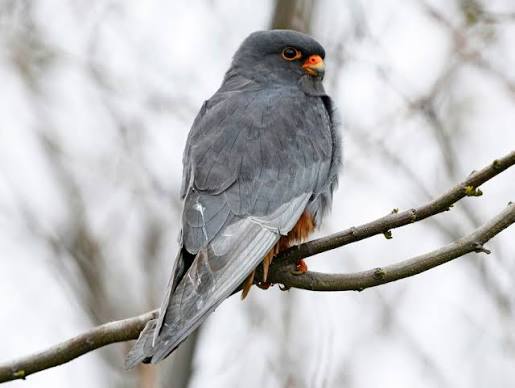
The male red-footed falcon is unmistakable when in good plumage. The body is entirely dark grey-slate. The thighs and undertail are vivid chestnut-orange. The cere and feet are bright red-orange. The eye ring is red. The combination of dark grey body with chestnut thighs and red bare parts makes the male one of the most distinctively marked small falcons in the region during the northern winter months.
The female shows orange-buff underparts with dark streaking. The crown and nape are orange-rufous. The face shows a dark mask and a pale supercilium. The upperparts are dark grey barred with black. Female and immature birds require careful observation but the orange-buff underparts and dark mask combination are distinctive once the observer is familiar with the species.
Immature birds show brown upperparts and streaked buff underparts similar to the female but with a less clearly defined head pattern. Large flocks in East Africa often contain a mixture of adult males, adult females, and immatures in varying plumages, making the flock a useful assembly for studying the age and sex variation within the species.
Behaviour in East Africa
Red-footed falcons hunt large insects, particularly termites and grasshoppers, during their stay in East Africa. The birds hawk insects in the air above the grassland and also drop to the ground to capture termites emerging from mounds during the post-rain emergence flights.
The communal roost behaviour creates some of East Africa’s most dramatic raptor spectacles. Large roost trees containing hundreds of red-footed falcons are visible from considerable distances as dark masses of perched birds. The pre-roost gathering in the late afternoon involves hundreds of individuals arriving simultaneously in fast, chattering flocks from different directions.
Furthermore, the species is strongly attracted to landscape fires during the dry season. The fleeing termites and grasshoppers flushed by the fire front provide a temporary food bonanza. Dozens or hundreds of red-footed falcons hunting at a fire front create one of East Africa’s most energetic and concentrated raptor displays of any time of the year.
Where to See Red-footed Falcons in East Africa
Red-footed falcons are most abundant in East Africa during October to November and March to April. Kenya’s open grassland zones, Tanzania’s Serengeti plains, and Uganda’s northern savanna all receive significant passage numbers during these migration windows.
The Rift Valley grasslands of Kenya and the Serengeti’s short grass plains produce the largest East African concentrations during peak migration events. The birds concentrate in areas of recent burning and in the grassland zones associated with large termite populations.
Tanzania’s northern Serengeti and the Mara Triangle in Kenya both produce peak red-footed falcon concentrations during the October to November period when the falcons are moving southward through the region toward their southern Africa wintering grounds.
Plan Your Birding Safari
Red-footed falcon sightings in large numbers require East Africa visits during October to November or March to April migration windows. Grassland destinations in Kenya’s Rift Valley and Tanzania’s northern Serengeti provide the most productive environment for encountering peak flock concentrations.
Any open savanna safari during the migration peak windows has a realistic chance of encountering large red-footed falcon gatherings over grassland and at burning sites without any specific searching effort beyond the standard game drive route.
African Wild Trekkers times East Africa birding safari itineraries to capture the peak raptor migration windows. Contact us to plan a safari that experiences East Africa’s most extraordinary raptor spectacle during the height of the migration season.