Pygmy Falcon Africa: The Continent’s Smallest Raptor and Its Weaver Nest Association
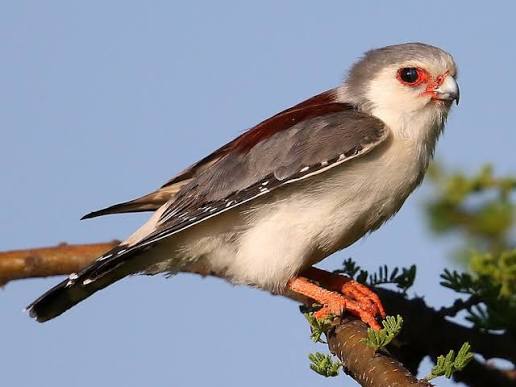
The African pygmy falcon is the smallest raptor species on the African continent. It measures only 19 to 20 centimeters from bill to tail—barely larger than a sparrow. Despite its tiny size, the pygmy falcon is a highly capable predator that captures lizards, large insects, and small birds with precision from its exposed perch positions in the dry bush habitats of East and South Africa.
The species has a well-documented and fascinating relationship with sociable weaver and white-headed buffalo weaver colonies. The pygmy falcon uses the unused chambers of these colonial nests for roosting and nesting rather than excavating its own nest site. The weaver colony provides the falcon with a ready-made nest structure. The presence of the falcon at the colony may provide some protection for the weavers through the alarm-calling behavior the falcon’s movements generate in the colony’s social network.
Identification
The male pygmy falcon shows white underparts and face. The upperparts are grey. The wings are black with white spots visible at close range. The tail is short and shows white outer feathers with black barring. The eye ring is vivid orange-red, matching the color of the cere and the legs.
The tiny size is the most immediately apparent feature when the bird is seen in the field. A pygmy falcon perched at the entrance of a buffalo weaver’s nest in a tall acacia appears disproportionately small relative to the nest structure and to the weavers moving around it. This size contrast is one of the most charming aspects of observing the species at a known nest association site.
Habitat and Distribution
The African pygmy falcon inhabits dry thorn savanna, semi-arid bush, and the arid grassland zones of East and South Africa. The species requires areas with large colonial weaver nests for roosting and nesting and is therefore most abundant where buffalo weaver colonies and sociable weaver colonies are established in suitable tree species.
In East Africa, the species is most reliably found in the drier parts of Kenya’s northern and eastern zones and in Tanzania’s dry Maasai steppe and Tarangire areas. The northern Kenya circuit centered on Samburu-Buffalo Springs National Reserve provides the most accessible and reliable pygmy falcon sighting opportunities within the established East Africa safari circuit.
The association with buffaloe weavers means that any large colony of these birds in dry thorn savanna habitat has the potential to hold pygmy falcons. Checking the nest holes of large buffalo weaver colonies for the small white face of a roosting pygmy falcon is one of the most productive field techniques for locating this species.
Where to See Pygmy Falcons in East Africa
Kenya’s Samburu-Buffalo Springs National Reserve provides the most reliable and accessible pygmy falcon sightings in East Africa. The reserve’s dry thorn savanna supports substantial buffalo weaver colonies in its riverside acacia trees. Resident pygmy falcons are present at these colonies year-round and are regularly pointed out by experienced Samburu guides to visiting birders.
Tanzania’s Tarangire National Park dry season provides another reliable location. The park’s dry acacia woodland in its southern sections carries both buffalo weavers and associated pygmy falcons accessible on standard game drives through the park.
Any dry savanna destination in northern Kenya and northern Tanzania with intact acacia woodland and established weaver colonies provides potential pygmy falcon habitat. The species is present wherever the conditions are right and rarely requires extensive searching at sites where a guide knows the active weaver colonies.
Plan Your Birding Safari
Pygmy falcon sightings are most reliable at Kenya’s Samburu-Buffalo Springs Reserve with an experienced local guide who knows the active buffalo weaver colonies. The species is present year-round at established sites and requires no specific seasonal timing.
Samburu combines the pygmy falcon with a remarkable array of other dry-zone specialties—Somali ostrich, Grevy’s zebra, reticulated giraffe, and a long list of dry-zone bird species found nowhere else in the standard East Africa circuit.
African Wild Trekkers includes Kenya’s northern dry-zone reserves in birding safari itineraries targeting Africa’s smallest falcon alongside the full northern Kenya wildlife experience. Contact us to plan a safari that explores East Africa’s most diverse dry-country wildlife community.