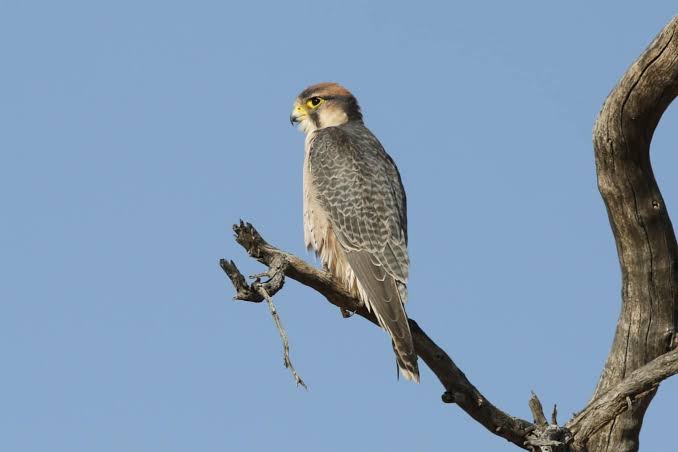
Lanner Falcon Africa: East Africa’s Most Widespread Large Falcon
The lanner falcon is East Africa’s most commonly encountered large falcon. It inhabits open country, cliffs, escarpments, and the open savanna zones throughout the region. The species is resident year-round across most of its East African range and does not require specific seasonal timing for reliable encounters. Any safari through open highland or escarpment country in Kenya, Tanzania, or Uganda will encounter lanner falcons on regular soaring flights or hunting passes over the open ground below.
The lanner falcon combines speed, agility, and a cooperative hunting strategy that allows it to capture prey far faster than itself. Pairs often hunt together, driving birds into the open and then taking turns at the pursuit until one falcon makes the capture. This team hunting tactic is one of the more sophisticated hunting strategies documented in any African raptor.
Identification
The lanner falcon measures 40 to 50 centimetres with a wingspan of 95 to 105 centimetres. The adult shows blue-grey upperparts and pale pinkish-white underparts with fine brown streaking. The head carries a distinctive rufous crown and nape that is clearly visible at close range and in good flight views. A narrow dark moustachial stripe runs below the eye.
The rufous crown distinguishes the lanner from the peregrine falcon, which shows an entirely dark head and darker underparts. The lanner is also slightly larger and more lightly built than the peregrine, with a proportionally longer tail and slightly broader wings.
Juvenile lanner falcons are considerably browner and more heavily streaked below than adults. The rufous nape is less well-defined in juveniles. The moustachial stripe is present and dark. Juvenile lanners are the most frequently confused falcon in East Africa due to their brownish, streaked appearance that overlaps with several other medium-sized raptors in the juvenile plumage.
Hunting and Speed
Lanner falcons hunt primarily birds in aerial pursuits. They are fast fliers capable of speeds exceeding 150 kilometres per hour in a stoop. The stoop is used to surprise prey from above or to intercept birds flushed from the ground by the hunting pair’s coordinated low passes.
The cooperative hunting strategy used by pairs allows them to capture prey in more open environments where a single falcon pursuing a bird directly is less effective.
Furthermore, lanner falcons are attracted to areas of landscape fire during the dry season where fleeing insects and small birds create temporary prey concentrations. A lanner pair hunting at the edge of a grass fire, intercepting fleeing grasshoppers and small birds in the rising smoke, is one of East Africa’s most dramatic raptor hunting spectacles.
Where to See Lanner Falcons in East Africa
Lanner falcons occur across East Africa’s open country, escarpment, and highland zones. The species is most commonly encountered perched on cliff edges, rocky outcrops, and the tops of tall isolated trees at escarpment locations throughout the region.
Kenya’s Rift Valley escarpments, Tanzania’s Ngorongoro highlands, and Uganda’s northern semi-arid zones all carry lanner falcon pairs in accessible locations. The falcons soar on thermals above the escarpments in the mid-morning hours and are visible from below at considerable distances when they catch the light on their pale underparts against the sky.
Samburu National Reserve in Kenya’s north and Tanzania’s Tarangire and Serengeti areas all produce lanner falcon sightings on game drives through the open country sections of these parks during morning raptor activity periods.
Plan Your Birding Safari
Lanner falcon sightings are most reliably achieved at open savanna and escarpment destinations throughout East Africa. The species requires no specialist access and appears regularly on standard game drives through appropriate open habitat in all three of East Africa’s main safari countries.
Cliff sites with known breeding pairs provide the most reliable encounter opportunities. Breeding pairs perch prominently near the nest cliff throughout the breeding season and are visible from the approach road in many accessible escarpment locations.
African Wild Trekkers includes open savanna and escarpment destinations in East Africa birding safari itineraries where lanner falcons are a regular raptor sighting. Contact us to plan a safari that explores East Africa’s full falcon diversity across the region’s open country and cliff habitats.