Black Rhino Facts: Africa’s Critically Endangered Hook-Lipped Browser
The black rhino once ranged across most of sub-Saharan Africa in populations that numbered around 65,000 in the 1970s. By 1993, poaching had reduced that population to fewer than 2,400 animals. It was the greatest proportional decline of any large African mammal in the twentieth century. Today, careful and expensive conservation work has brought the number back to approximately 6,500. The black rhino remains critically endangered — the most threatened of all five rhino species.
What Is the Black Rhino?
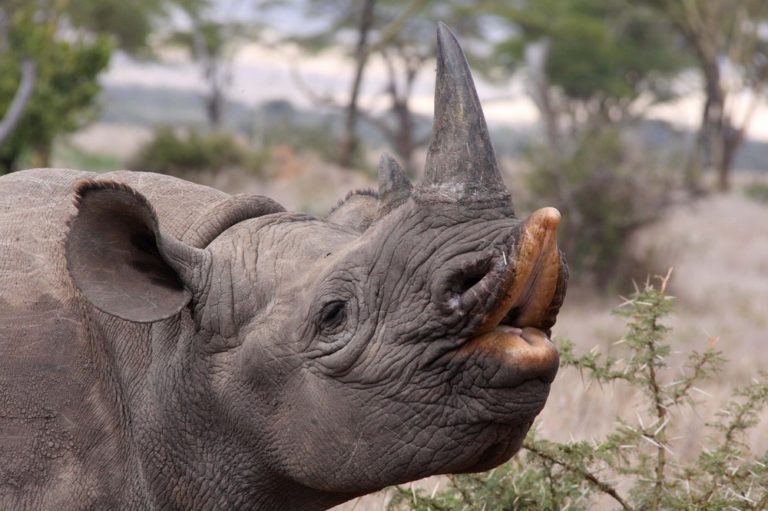
The black rhino, Diceros bicornis, is smaller and more agile than the white rhino. Its most diagnostic physical feature is the pointed, prehensile upper lip—a hooked structure used to grasp and pull woody vegetation. This browsing lip is the opposite of the white rhino’s wide, flat grazing lip. The two species are therefore adapted to entirely different food sources despite living in overlapping habitats.
An adult black rhino weighs between 800 and 1,400 kilograms. Body length reaches about 3 to 3.7 meters. The anterior horn averages 50 centimeters but can exceed 130 centimeters in older individuals. Four subspecies are recognized, though one—the western black rhino—is now extinct. The eastern black rhino is the most common surviving subspecies and the one present in East Africa.
Browser Not Grazer: The Dietary Difference
The black rhino eats leaves, shoots, and twigs from woody plants. Acacia, euphorbia, and various shrub species make up the majority of its diet. It reaches up to 2 meters to grasp branches with the hooked upper lip and pull them down. The thorns of acacia species do not deter it—the black rhino’s hide is thick enough to resist minor thorns, and the mouth’s toughened skin handles spiny browse without apparent discomfort.
This browsing niche separates the black rhino from the white rhino ecologically. The two species can coexist in the same protected area—as they do in Kenya’s Ol Pejeta Conservancy and in the Ngorongoro Crater—because they eat from different vegetation layers. This niche separation reduces competition and allows higher combined densities than either species could sustain alone.
Solitary and Territorial
Black rhinos are more solitary and more aggressive than white rhinos. Adults are largely solitary except for mother-calf pairs and breeding encounters. Males hold scent-marked territories ranging from 2 to 30 square kilometers. Female home ranges are larger and less rigidly defended. Encounters between adults involve aggressive displays—head-raising, horn-lowering, and snorting—and occasionally escalate to genuine fights that produce serious tusk wounds.
The black rhino’s reputation for unpredictable charging is well-founded. It has poor eyesight and relies heavily on smell and hearing. An animal that detects a human scent or an unfamiliar sound may charge directly toward the source before assessing visually whether the threat warrants it. This reactive charging is a defensive behavior that served the species well against natural predators but creates genuine danger in encounters with humans or vehicles that approach too closely.
Range in East Africa
Kenya holds about 800 black rhinos—the largest single national population remaining. The Maasai Mara ecosystem, Nairobi National Park, Lake Nakuru, and Ol Pejeta Conservancy all hold significant numbers. Tanzania’s Ngorongoro Crater holds a small but stable population that has recovered from historic lows of around 11 animals in 1995. Rwanda’s Akagera National Park received five black rhinos from South Africa in 2017 — the first black rhinos in the country in decades.
Conservation: A Fragile Recovery
The recovery of the black rhino from under 2,400 to over 6,500 individuals is a genuine conservation achievement. The Kenya Wildlife Service’s rhino program, the Lewa Wildlife Conservancy model, and community-based conservancies around Laikipia have all contributed. But the remaining population is still below 10 percent of 1970s levels. The species remains critically endangered, and poaching pressure — though reduced from its peak — never fully disappears from any population.
Plan Your Safari
Kenya offers the best black rhino encounters in East Africa. Ol Pejeta Conservancy in Laikipia has the largest black rhino population in the world outside South Africa and offers vehicle and walking encounters. Nairobi National Park—remarkably—holds black rhinos 10 kilometers from Nairobi’s city center. Tanzania’s Ngorongoro Crater virtually guarantees black rhino sightings on a full-day crater descent. Rwanda’s Akagera now offers rare black rhino sightings with a growing young population.
African Wild Trekkers designs Kenya itineraries that include Laikipia’s Ol Pejeta and Lewa conservancies for dedicated black rhino encounters. Contact us to plan a safari around this critically endangered giant.