Eland Facts Africa: The World’s Largest Antelope
The eland is the world’s largest antelope. A bull can weigh over 900 kilograms — more than many buffalo. Despite this mass, it is one of the most agile large mammals in Africa.
It jumps fences over 3 meters high with ease and trots at 22 kilometers per hour for hours. It runs at 70 kilometers per hour in short sprints.
The eland combines improbable size with improbable athleticism, and it does so with a quiet, almost bovine dignity that makes it one of the most underrated animals in East Africa.
What Is a Common Eland?
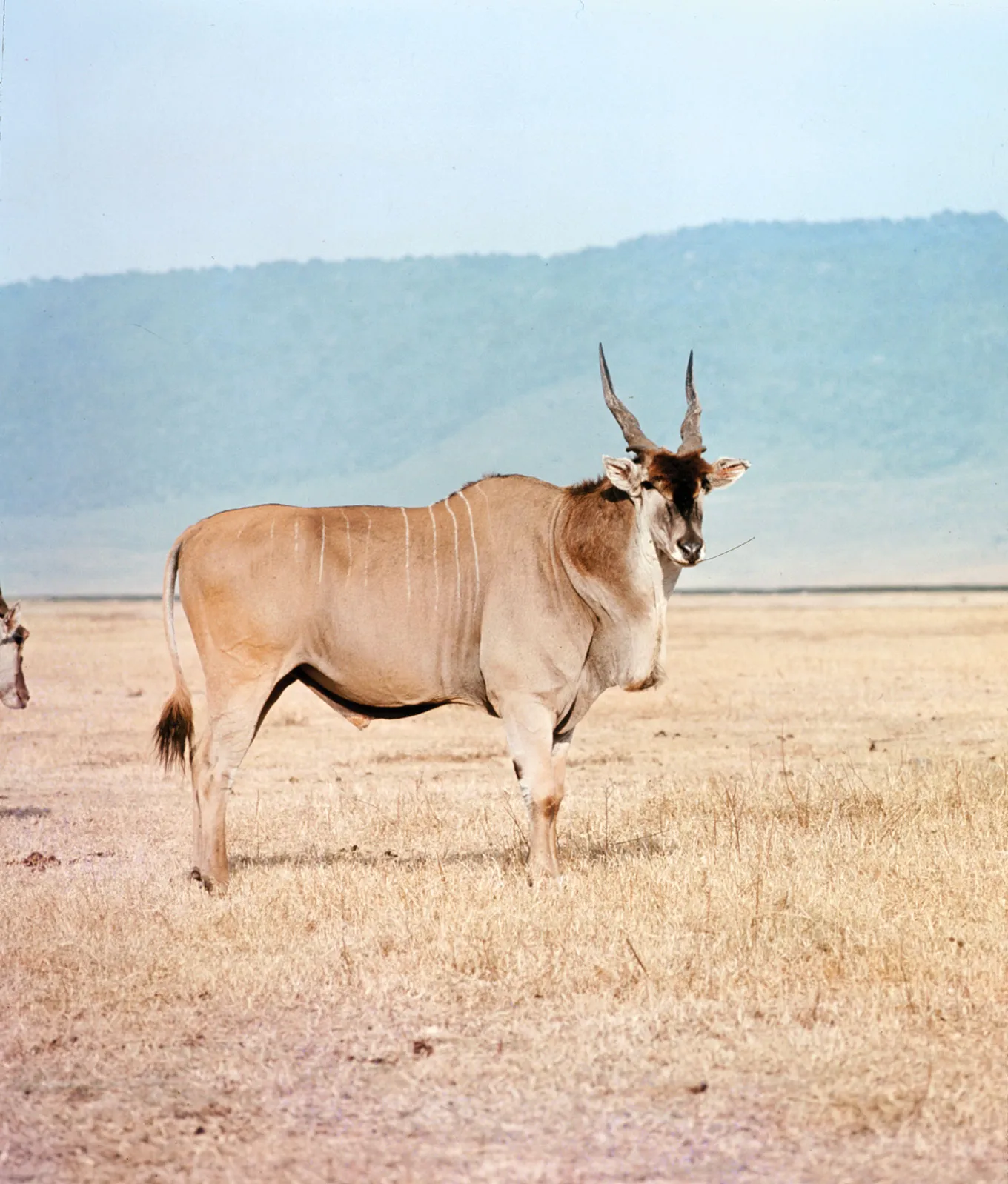
The common eland, Tragelaphus oryx, belongs to the spiral-horned antelope group—the same family as the kudu, bushbuck, and bongo. An adult bull weighs between 400 and 950 kilograms.
Cows weigh between 300 and 600 kilograms. Shoulder height reaches 1.6 meters—nearly as tall as a buffalo but more finely built through the legs. The coat is tawny-tan in females and young males and greyish-blue in old bulls.
A prominent dewlap hangs from the throat of adults, more pronounced in bulls.
Both sexes carry spirally twisted horns that grow straight upward from the head. In males the horns are heavier and may reach 65 to 100 centimeters.
The horns are used in male competition through horn-pressing and shoving contests. Bulls do not use their horns in the slashing manner of many bovids—they lock horns and push.
The Clicking Gait: Why Elands Click
Walking elands produce a loud clicking sound with each step. This clicking is audible from 30 to 50 meters and is one of the most distinctive sounds of East Africa’s savanna woodland.
The source of the click has been debated—proposed explanations include the tendons of the foreleg, the hooves splitting on contact with the ground, and the knee joints.
Recent evidence points most strongly to the splitting and snapping together of the split hooves as the foot lifts.
The click may function as a communication signal. Elands use the sound to maintain contact with herd members in dense bush where visual contact is limited. Bull elands produce louder clicks than cows.
In captive studies, elands responded to playback of clicking sounds by orienting toward the speaker. The click appears to communicate identity, location, and possibly status within the herd.
Herd Structure and Movement
Elands form the largest herds of any spiral-horned antelope. Groups of 30 to 70 individuals are common.
Transient herds of several hundred form on the open Serengeti plains during the wet season when eland concentrate around new grass growth.
These large transient herds are not stable social units—individuals join and leave freely. The core social unit is a smaller group of females with their calves.
Elands are nomadic rather than territorial. They range widely, following food quality across seasons. A herd may cover several hundred kilometers in a year across the Serengeti ecosystem.
The lack of territorial behavior means elands do not compete with resident territorial antelopes in the same way—they move through territories without triggering defensive responses from resident males of other species.
Conservation and Significance
The eland was domesticated by several African cultures historically. San communities in southern Africa hunted the eland as a primary food source and gave it spiritual significance in rock art traditions.
Pastoralist communities across East Africa regard eland fat as medicinally and nutritionally superior to other game animals. The eland’s high milk yield and relatively calm temperament have made it the subject of domestication experiments in Russia and Zimbabwe, with mixed commercial success.
Plan Your Safari
Elands are widespread but never numerous enough to be taken for granted. Kenya’s Maasai Mara, Tanzania’s Serengeti, and the Ngorongoro Crater all produce reliable eland encounters.
The Laikipia Plateau in Kenya holds significant eland populations on private conservancies. Uganda’s Kidepo Valley National Park offers exceptional eland watching on its open savanna—Kidepo has some of the most relaxed and approachable eland herds in East Africa.
African Wild Trekkers builds Kidepo and Laikipia into specialist itineraries for visitors who want to see East Africa’s larger and less-celebrated antelopes. Contact us to design a safari that goes beyond the standard circuit.