Hartebeest Facts Africa: The Strange-Headed Antelope That Surprises Everyone
First-time safari visitors often dismiss the hartebeest. Its elongated face, bracket-shaped horns, and sloping back give it an ungainly appearance that sits awkwardly beside the elegance of a kudu or the power of a buffalo. But spend time watching a hartebeest, and the picture changes.
It is one of the fastest antelopes in East Africa. It is a vigilant sentinel for the entire grazing community. And its social structure is more nuanced than its unglamorous reputation suggests.
What Is a Hartebeest?
The hartebeest belongs to the subfamily Alcelaphinae—the same group as wildebeest and topi. Several species and subspecies occur across Africa. In East Africa, two subspecies are commonly encountered.
Coke’s hartebeest, Alcelaphus buselaphus cokii, is the red-brown subspecies found across Kenya and Tanzania’s open savanna.
The Lelwel hartebeest, Alcelaphus buselaphus lelwel, replaces it in Uganda and parts of northern Kenya.
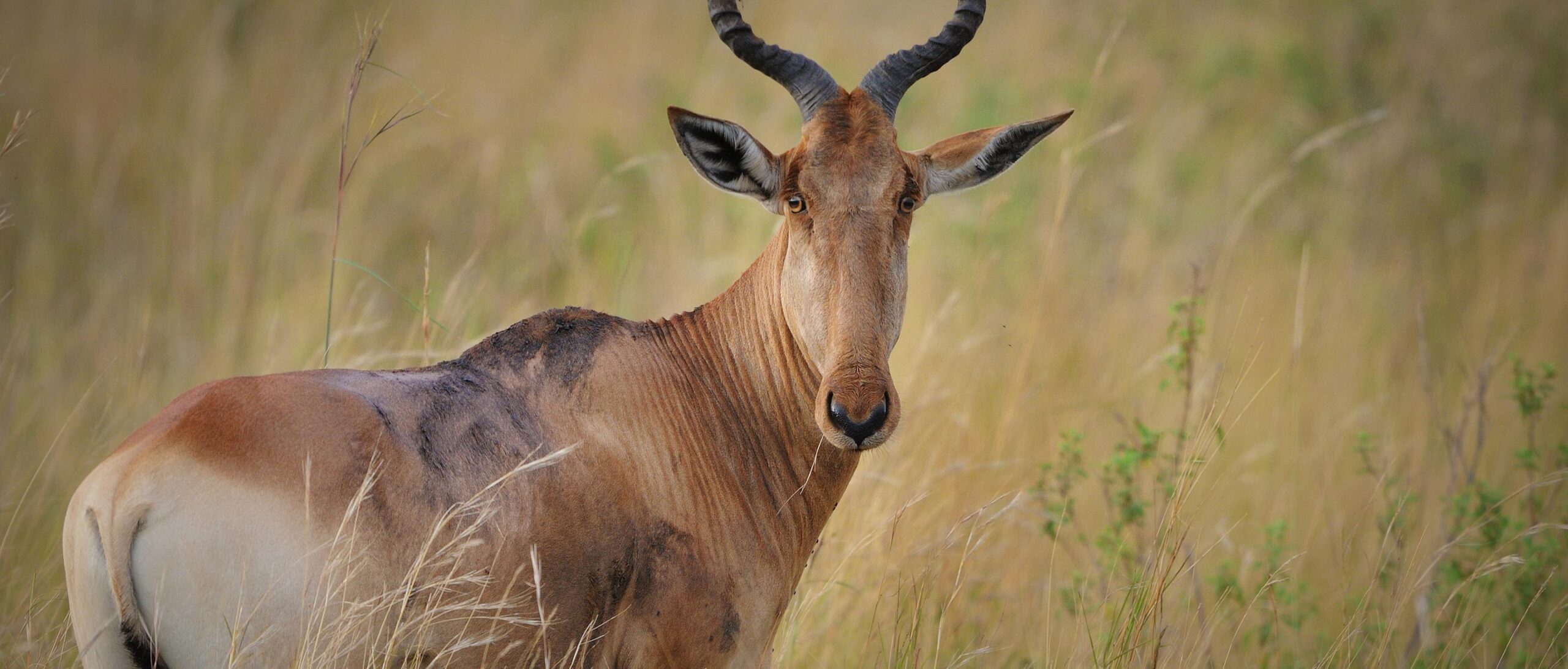
An adult hartebeest weighs between 100 and 200 kilograms. Body length reaches 2 meters. The head is notably elongated—the pedicle carrying the horns sits atop a long, narrow skull that gives the animal a profile unlike any other African antelope.
The horns in both sexes grow upward, then curve outward, then curve back inward—forming the distinctive bracket or U-shape that distinguishes the hartebeest from all similar species.
The Head: Not as Strange as It Looks
The hartebeest’s extended skull and pedicle position the horns high above the head. This elevation increases the effective length of the horn weapon in male-male combat.
During head-on fighting, two males engage horn to horn at a height above the eye level of most competing antelopes. The long skull also provides a longer attachment area for the powerful neck muscles used in combat.
What appears bizarre is in fact a fighting-optimized head architecture.
The elongated face extends the dental row, giving the hartebeest a larger molar surface area per unit body size than similar-sized alcelaphines.
This is a grazing adaptation — more molar surface area means faster processing of the fibrous grass that forms the primary diet. The hartebeest’s unusual face is built for both fighting and feeding.
Speed and Flight Response
The hartebeest reaches 65 to 70 kilometers per hour in full flight. It is one of the fastest antelopes in East Africa — faster than wildebeest, faster than zebra, and comparable in top speed to the topi.
When alarmed, the group freezes, raises heads, and stares at the threat source before the flight response triggers. This brief freeze — sometimes several seconds — allows the animal to confirm the threat and orient escape direction before committing to the energy expenditure of a full sprint.
Hartebeest in mixed grazing groups respond to alarm calls from other species—particularly topi and Thomson’s gazelles.
The multi-species alarm system of the open savanna extends the effective detection radius of any individual hartebeest well beyond its own sensory range.
Social Structure and Territory
Hartebeest live in herds of 6 to 30 individuals. Territorial males hold year-round territories in areas with high female concentration. Non-territorial males form bachelor groups that move widely across the savanna.
Territorial males mark their boundaries with dung middens and horn-rubbing on grass and soil. They display from elevated termite mounds—the same sentinel behavior seen in topis—broadcasting their territorial presence to rivals and to females assessing available mates.
Range in East Africa
Coke’s hartebeest is a regular sighting across the Serengeti, Ngorongoro, and the Maasai Mara. Kenya’s Nairobi National Park and Amboseli hold resident populations.
The Lelwel hartebeest occurs in Uganda’s Murchison Falls National Park and on the game reserves of northern Uganda near the South Sudan border. Jackson’s hartebeest — sometimes considered a separate subspecies — occurs near Uganda’s Kidepo Valley National Park.
Plan Your Safari
Hartebeest are best appreciated when watched over time. The sentinel behavior, the bachelor group dynamics, and the territorial male’s interaction with passing female groups all become visible after 15 to 20 minutes of patient observation.
The Serengeti’s central Seronera area, the Ngorongoro Crater, and Uganda’s Murchison Falls all provide reliable hartebeest encounters on open plains where the full range of their behavior is visible from a vehicle.
African Wild Trekkers designs East Africa safaris that give time to the full range of the continent’s antelope diversity. Contact us to plan a trip that goes beyond the obvious species.