Little Bee-eater Facts: East Africa’s Smallest and Most Widespread Bee-eater
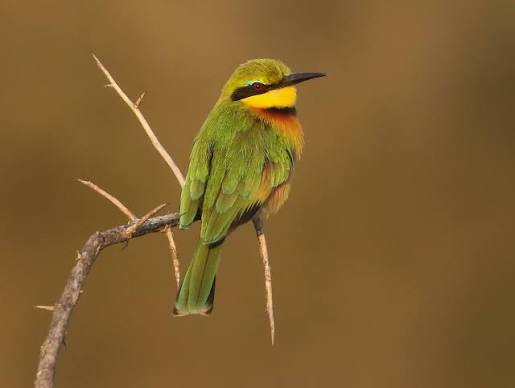
The little bee-eater is East Africa’s smallest bee-eater species and its most commonly encountered. Measuring only 15 to 17 centimetres, it is roughly half the size of the carmine bee-eater. Despite its modest dimensions, the little bee-eater carries the family’s characteristic brilliant plumage in miniature — green upperparts, yellow throat with a black breast band, and rufous-orange underparts. It is one of the most familiar sights on any East Africa safari that passes through open woodland, grassland, or the edges of wetland vegetation.
The little bee-eater is a solitary hunter rather than a colonial species. It hunts from low perches in open vegetation, returning to the same stems repeatedly throughout the day between hunting sallies. This perch hunting behaviour makes it one of the easiest bee-eaters to observe well, as it sits in exposed positions for extended periods between flights.
Identification
The little bee-eater shows green upperparts and a yellow throat separated from the rufous-orange underparts by a clean black breast band. The crown is green. The tail shows elongated central feathers but these are considerably shorter relative to body size than those of the larger bee-eater species. The overall impression is of a tiny, beautifully marked bird that packs the full bee-eater colour scheme into a very small package.
The black breast band is the most useful identification feature. No other small green bee-eater in East Africa shows this combination of yellow throat and black breast band in the same plumage. The combination immediately identifies the species from any angle in which the underparts are visible.
The call is a soft, high-pitched “tseet” note given quietly in flight between perches. The call is easily missed in areas with competing bird sounds but becomes familiar once the observer has noted it several times in association with the bird’s characteristic flight pattern.
Hunting Behaviour and Diet
Little bee-eaters hunt flying insects from exposed perches at low heights in the vegetation — typically between 0.3 and 2 metres above the ground. They sit upright on a grass stem, reed stalk, or low bush branch and watch for flying insects in the air space around the perch. When an insect is detected, the bird launches in a fast, direct sally, captures the insect in its bill, and returns to the same or a nearby perch.
Bees, wasps, and hornets are the primary prey. The bird neutralises the stinging insects before swallowing them by beating them against the perch and rubbing the abdomen against the stem to discharge the venom gland and remove the sting. The rubbing movement is rapid and precise. A skilled little bee-eater completes the sting removal in less than 3 seconds before swallowing the prey.
Additionally, the little bee-eater takes non-stinging insects including dragonflies, damselflies, and large beetles. Dragonflies are caught in fast sallies over open water or above grassland where they are most abundant. The catch rate for dragonflies is high because their large size and slow, predictable flight make them easier targets than the rapid zigzag flight of smaller insects.
Distribution and Where to See Little Bee-eaters
Little bee-eaters are present throughout East Africa in every habitat except dense forest and bare desert. They are among the most widespread and reliably encountered birds on any safari regardless of the specific destination. Any open grassland, savanna, woodland edge, or wetland margin in Kenya, Uganda, or Tanzania carries little bee-eaters in resident or visiting numbers throughout the year.
Lake Naivasha in Kenya, Queen Elizabeth National Park in Uganda, and Tanzania’s Tarangire and Serengeti ecosystems all produce consistent little bee-eater sightings on every game drive through grassland and woodland edge habitat.
Plan Your Birding Safari
Little bee-eater sightings require no specialist effort on any East Africa safari. The species is encountered on nearly every game drive in every destination across the region. It is among the first bee-eater species that first-time visitors learn to identify by name, and it subsequently becomes a reassuring daily constant on longer safari trips.
The best close-range views occur when a hunting bird selects a perch stem close to a stationary vehicle and resumes hunting from a position within 3 to 4 metres. Waiting quietly in the right habitat allows this to happen naturally.
African Wild Trekkers designs East Africa safari itineraries where little bee-eaters are a daily feature of the open savanna wildlife experience. Contact us to plan a safari that captures the full spectrum of East Africa’s extraordinary bee-eater diversity.