Genet Facts Africa: The Spotted Acrobat You Might See at Your Safari Lodge
You sit at dinner at your safari lodge. The lights are low. Something moves in the rafters. Long-bodied, spotted, with a tail twice the length of its torso. It walks a beam with the precision of a tightrope walker. This is the genet—not a cat, but something older, stranger, and just as graceful.
What Is a Genet?
Genets belong to the family Viverridae, the same family as civets. They are not cats, though they are often called civet cats or genet cats in informal usage. They diverged from the lineage that produced cats roughly 50 million years ago. Today Africa has multiple gene species. The common genet and the large-spotted genet are the two species most frequently encountered in East Africa.
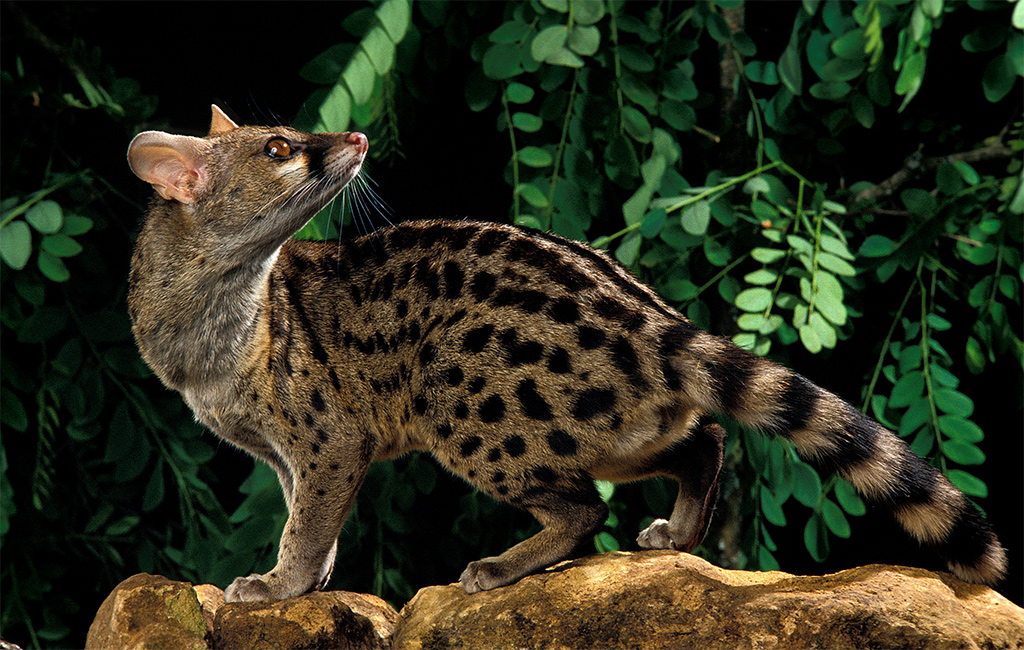
An adult genet weighs between 1.5 and 3 kilograms. The body length reaches about 45 centimeters. The tail adds another 40 to 50 centimeters. This long tail is the genet’s most immediately recognizable feature. It uses it for balance during arboreal movement and as a communication tool with other genets.
Physical Features: Spots, Stripes, and That Tail
The genet’s coat is pale grey to yellowish-white with rows of dark brown or black spots along the flanks. A dark dorsal stripe runs from nape to tail base. The face has a pointed muzzle, large amber eyes, and tall, rounded ears. The semi-retractile claws grip bark and branch surfaces with precision.
The large-spotted genet, found across Uganda and much of East Africa, has bigger, rust-tinged spots. The common genet has smaller, sharper spots. Both species have a distinctly banded tail—alternating dark and pale rings running to a dark-tipped end. Field identification between the two requires close observation of spot color and size.
Diet and Hunting Strategy
Genets are carnivores that supplement their diet with fruit and insects. Their primary prey includes rodents, birds, lizards, frogs, and large insects. They hunt both on the ground and in trees. Tree hunting makes them unusual among small African carnivores. They move through the canopy in darkness, using their whiskers and eyes to locate roosting birds.
A genet kills small prey with a rapid bite to the back of the skull. It is fast and decisive. It pursues prey through branches and shrubs without losing its footing. The long flexible spine allows it to squeeze through gaps and change direction quickly mid-chase. Few small prey items escape a hunting genet once it commits to the chase.
Why Genets Visit Safari Lodges
Genets follow prey, and prey follows humans. Safari lodge kitchens, storage areas, and dining spaces attract rodents. Rodents attract genets. Over time, individual genes learn that a lodge provides reliable food. They become semi-habituated to lights and the presence of people. Some lodges in Uganda, Kenya, and Tanzania have genets that visit every night after dinner.
The Mweya Safari Lodge at Queen Elizabeth National Park in Uganda has resident genets that walk the dining area beams each evening. Several lodges in the Maasai Mara have the same. These encounters require no special arrangement — just an awareness that the movement in the rafters is worth watching closely.
Range and Habitat in East Africa
Genets live across sub-Saharan Africa. They require some form of vegetative cover—forest, dense bush, riparian thicket, or woodland. They are absent from open, treeless savanna and true desert. In East Africa they live throughout Uganda, Rwanda, Kenya, and Tanzania. They reach higher elevations than most small carnivores, living at over 3,000 meters in some highland areas.
Genetic Vocalization: A Rarely Heard Sound World
Genets are quiet animals. Their vocalizations are infrequent and often missed entirely. The most common sound is a soft, purring contact call made between individuals in close proximity. When threatened or cornered, a genet produces a sharp, cough-like bark combined with a raised-back defensive display. The crest along the dorsal line stands erect and the tail bushes out, making the animal appear significantly larger than it is.
Young genets produce a persistent high-pitched mew when isolated from the mother. This call triggers an immediate retrieval response from the adult. Genets do not maintain long-distance vocal communication the way jackals or mongooses do. Their social contacts are infrequent, and most communication happens through scent marks deposited along regular travel routes rather than through calls.
Genet Population Status and Conservation
The common genet and large-spotted genet are both classified as Least Concern by the IUCN. Both species are widespread across sub-Saharan Africa. Genets adapt well to secondary vegetation, forest edge, and low-intensity farmland. They exploit the rodent communities that agricultural land supports and persist in modified habitats where many other small carnivores cannot.
Genets are occasionally killed for bushmeat or in retaliation for raiding poultry. Their semi-arboreal habits reduce road mortality risk compared to ground-dwelling carnivores. The main long-term threat is the loss of dense bush and forest cover that provides daytime shelter and hunting terrain. Intense land clearance that removes all woody vegetation pushes genets out of an area even when rodent prey remains abundant. Protected areas and conservancies that maintain woodland structure retain genet populations reliably.
Plan Your Safari
The easiest genet viewing in East Africa happens at lodges. Ask lodge staff whether genets visit regularly before you book. Queen Elizabeth National Park and the Bwindi region in Uganda, and several lodges in the Maasai Mara and Aberdare Highlands in Kenya, all have reliable nightly visitors.
For a more active encounter, night drives through forest edges and riverine woodland produce genet sightings. They freeze briefly in a spotlight before continuing. Their eyes reflect brightly—a long, low pair of orbs that announces a gene immediately once you know what to look for.
African Wild Trekkers selects lodges in part based on their nocturnal wildlife activity. Contact us, and we will include lodge-genet viewing as part of your East Africa itinerary.