Leopard Tree Resting: Why Africa’s Most Secretive Cat Sleeps in the Canopy
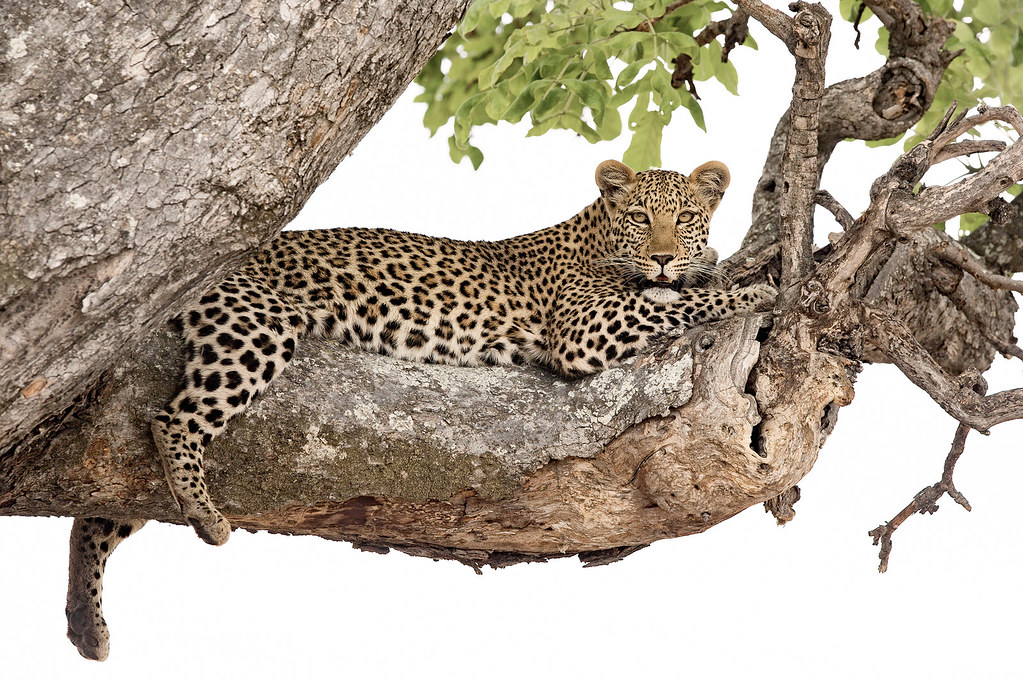
You look up. In the fork of a sausage tree, draped across a branch with its legs hanging, a leopard sleeps. The scene looks relaxed to the point of carelessness. In reality, this position represents a calculated set of decisions. The leopard chose this tree over hundreds of others. It climbed at a specific time. It rests here for specific reasons. Understanding leopard tree resting unlocks one of East Africa’s most photogenic and misunderstood wildlife behaviors.
Why Leopards Rest in Trees
The primary reason leopards rest in trees is safety. Lions steal leopard kills on the ground with regularity. A leopard that spends daylight hours in a tree with a hoisted carcass feeds undisturbed. Lions cannot climb to access a leopard’s cache. Spotted hyenas cannot climb at all. The tree transforms a vulnerable ground position into a defensible, elevated sanctuary.
Temperature regulation is a secondary benefit. The ground surface in open savanna reaches temperatures that make resting uncomfortable and physiologically costly during midday. A tree canopy is 4 to 8 degrees cooler than the ground beneath it. Airflow in the canopy removes heat more efficiently than still ground-level air. A leopard resting in a tree spends less energy on thermoregulation and wakes up better rested for the evening hunt.
How Leopards Choose Their Trees
Leopards are not indiscriminate about which trees they use. Individual leopards develop strong preferences for specific trees within their territories. These preferred trees appear in camera trap data year after year. The preference correlates with branch architecture. A leopard needs a fork or a broad horizontal branch that supports its body weight comfortably. The fork must sit high enough—typically 3 to 6 meters—to be above the reach of lions and hyenas.
In East Africa, fig trees, sausage trees, acacia species, and large terminalia are consistently chosen. Sausage trees in particular — abundant in Uganda’s Queen Elizabeth National Park and the Maasai Mara — provide horizontal branches of ideal diameter. The bark texture matters too. Rough, gripping bark makes climbing and descending faster and more secure. Smooth-barked trees in leopard territory show less use than rough-barked alternatives even when branch architecture is similar.
Hoisting Prey Into Trees
A leopard hoisting a carcass heavier than itself is among the most extraordinary physical acts in African wildlife. Adult impala weigh between 40 and 75 kilograms. An adult female leopard weighs 28 to 45 kilograms. The leopard carries or drags the carcass to the tree base, grips it by the neck with its jaws, and climbs vertically using forepaw and hindpaw alternation in a series of short, powerful bursts.
The neck muscles, forelimbs, and jaw musculature of the leopard are disproportionately developed relative to its body size—more so than any other comparably sized cat. This reflects the evolutionary pressure of needing to hoist prey. A leopard that cannot hoist its kill loses it. A leopard that consistently hoists successfully eats more food per hunt than one that cannot.
Tree Resting Without a Kill
Leopards also rest in trees when they carry no food. In this case the behavior functions as concealment. A leopard lying flat on a high branch in dappled shade is nearly invisible from below. The spotted coat breaks the outline of the body against a background of light and shadow in the canopy. Ground-level observers — including prey animals — frequently walk directly below a resting leopard without detecting it.
This invisibility is strategically useful. A resting leopard above a waterhole or game trail is watching the approaches below it. When prey walks within range, it drops from the tree in a vertical ambush. This hunting technique is less common than ground-level stalking but is documented in multiple East African populations. It requires no energy expenditure during the waiting phase and delivers the prey directly below the tree where hoisting is most efficient.
The Best Trees for Leopard Watching
Experienced guides in East Africa’s leopard-rich areas know the specific trees that leopards use repeatedly. These trees become reliable stopping points on game drives. Returning to the same sausage tree on a second game drive often produces the same individual that was not there on the first. Individual leopard territories in prime habitat are small enough that a guide tracking a specific animal can anticipate its movements with good accuracy.
In Uganda’s Queen Elizabeth National Park, the channel drive between Mweya and Kabatoro produces regular sausage tree leopard sightings. The Maasai Mara’s Mara River area has several well-documented fig trees that serve as regular resting sites. Tanzania’s Serengeti’s kopje country near Seronera has established individual leopards with known tree preferences mapped over decades of research.
Plan Your Safari
Leopard watching requires patience, a knowledgeable guide, and time in the right habitat. Long stays in one location with a good guide who knows individual animals produce the best encounters. The Maasai Mara, Serengeti, and Uganda’s Queen Elizabeth National Park all deliver reliable leopard sightings to visitors who take multiple game drives across several days.
African Wild Trekkers works with experienced leopard guides in all three of East Africa’s top leopard zones. Contact us to design a safari built around finding this beautiful and elusive cat in its favorite trees.