Banded Mongoose Africa: The Social Forager of East Africa’s Savanna
A pack of banded mongooses moves across the savanna like a small, fast-moving team with a shared purpose. Every individual keeps its nose to the ground. Every individual stays within sight of the others. Short, sharp churring alarm calls rise and fall in milliseconds as the pack monitors sky and grass simultaneously. Banded mongooses produce more behavioural watching per minute than almost any other mammal in the safari ecosystem.
What Is a Banded Mongoose?
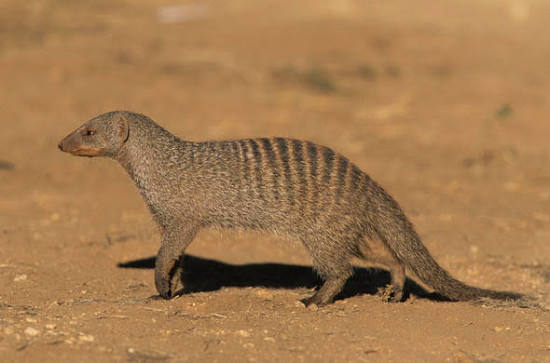
The banded mongoose, Mungos mungo, is a medium-sized social mongoose. Adults weigh between 1.5 and 2.5 kilograms. Body length reaches 30 to 45 centimetres with a tail of similar length held semi-erect during movement. Grey-brown fur carries 10 to 15 darker transverse bands across the back from behind the shoulders to the tail base. These bands name the species and make field identification against other East African mongooses straightforward.
East Africa’s only banded-back mongoose, this species is closely related to the Gambian and Liberian mongooses of West Africa. Yellow-amber eyes and long, robust claws suited to digging complete the field picture.
Pack Life and Cooperative Behaviour
Banded mongoose packs contain 10 to 40 individuals. Unlike the dwarf mongoose which has only one breeding female multiple females breed simultaneously in banded mongoose packs. Pups from different females raise together communally. All pack members contribute to pup guarding and feeding. Guardians stay behind with pups at a babysitting location while the rest of the pack forages. Returning hunters regurgitate food for pups before the next foraging bout.
Constant low-level calling maintains pack cohesion during foraging soft murmuring contact notes between members as they spread across an area. These calls communicate position without requiring visual contact in tall grass. When a raptor or snake triggers an alarm call, the pack condenses immediately. Individuals stand upright and scan before either retreating or mob-attacking the threat.
Diet: The Invertebrate Specialists
Banded mongooses specialise in invertebrates. They dig for beetle larvae, termites, millipedes, earthworms, and other soil-dwelling prey. Hard-shelled dung beetles meet a distinctive fate pack members throw them backward against rocks to crack the shell. Fallen fruit, small vertebrates, bird eggs, and carrion supplement this diet. Frogs and lizards are caught and eaten on encounter.
Collective foraging efficiency far exceeds that of any solitary mongoose. Twenty individuals scanning an area simultaneously cover more ground per unit time, detect buried prey from more angles, and each individual encounters more prey than it would forage alone.
Snake Mobbing
When pack members detect a venomous snake, all individuals converge on it. They adopt upright posture, produce the churring alarm call, and rush the snake from multiple angles retreating when it strikes, pressing forward when it recovers. This collective harassment typically drives the snake from the foraging area. Mongooses resist many snake venoms through a genetic adaptation shared across the family. Pack mobbing reduces individual envenomation risk even further.
Plan Your Safari
Banded mongooses live in most East Africa national parks with open savanna and woodland. Queen Elizabeth National Park in Uganda is particularly productive the Mweya peninsula and Kazinga Channel area hold resident packs observable at close range. The Maasai Mara and Serengeti produce sightings on most game drives in woodland zones. A pack at a termite mound with every individual foraging and the alarm system constantly operating is one of East Africa’s most reliably entertaining small-mammal sightings.
African Wild Trekkers designs East Africa safari itineraries that pay attention to smaller mammals alongside the large. Contact us to plan a safari capturing the full range of East Africa’s extraordinary wildlife.