Dwarf Mongoose Facts: Africa’s Smallest Carnivore and Its Termite Mound Kingdom
The dwarf mongoose weighs less than 350 grams. Africa’s smallest carnivore lives in groups of up to 30 individuals under a single breeding female — the alpha. It forms one of Africa’s most documented interspecies alliances with hornbills. It maintains one of the most sophisticated sentinel systems of any East African mammal. Small does not mean simple.
What Is a Dwarf Mongoose?
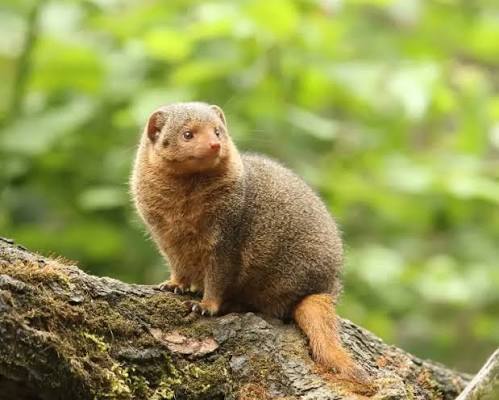
The dwarf mongoose, Helogale parvula, is the smallest mongoose in Africa. Adults weigh between 210 and 350 grams. Body length reaches 18 to 28 centimetres with a tail of 12 to 20 centimetres. The coat is uniform dark brown to olive-brown. Amber eyes and a small, rounded snout give the face its characteristic alert expression. Despite the miniature scale, the proportions are unmistakably mongoose — elongated, short-legged, with a tapered tail.
Large termite mounds are the key to finding dwarf mongooses. Each pack uses 20 to 30 termite mounds within its territory as rotating den sites. Termites long ago vacated these mounds — roots later invaded the chambers, creating a tunnel network with multiple entrances. The mounds provide security from rain, temperature extremes, and predators. Packs move between mounds on a roughly weekly rotation.
The Alpha Female Breeding System
A single alpha female dominates each pack. She breeds exclusively in most packs. Her partner — the alpha male — holds mating access in most circumstances. All other pack members are subordinates, typically offspring of previous litters, who help raise pups through feeding, grooming, and guarding. This cooperative breeding with subordinate helpers is one of East Africa’s clearest examples of inclusive fitness in action.
Behavioural suppression of subordinate females maintains the alpha female’s reproductive monopoly. Her dominance and presence reduces other females’ reproductive activity. When the alpha female dies, the next-ranking female takes her place and begins breeding within weeks. Stable packs maintain their alpha pair for several years.
The Hornbill Alliance
Dwarf mongoose packs forage alongside yellow-billed and red-billed hornbills in a consistent mutualistic relationship. As mongooses move through leaf litter, they flush invertebrates and small vertebrates — food for the hornbills that follow overhead and pick up escaping insects. In return, hornbills sound alarm calls alerting mongooses to aerial predators — hawks and eagles — that the low-slung mongooses cannot detect as early as the elevated birds. Mongooses respond to hornbill raptor alarms as reliably as to their own alarm calls. Experiments have confirmed this cross-species alarm response.
Sentinel System
During foraging, one or two mongooses leave the pack to climb elevated perches — grass clumps, termite mound tops, low branches. They watch for predators while the others feed. The sentinel gives an all-clear call at regular intervals. When a threat appears, a specific call for the threat type — aerial or terrestrial — triggers a different response from the pack. Sentinel duty rotates between pack members spontaneously, with no individual dominating the role.
Plan Your Safari
Dwarf mongooses live in most East Africa savanna parks. Large termite mounds in open Acacia and Brachystegia woodland are the place to find them. The Maasai Mara conservancies, Tarangire’s termite-rich woodland, and Queen Elizabeth’s open areas all produce reliable sightings. Stopping at a large termite mound and watching quietly for five minutes frequently reveals a pack emerging or returning. Movement patterns are predictable once you know the mound.
African Wild Trekkers includes small mammal observations as a deliberate part of the safari experience. Contact us to plan an East Africa itinerary that looks beyond the Big Five to the remarkable smaller wildlife.