Yellow Baboon Tanzania: The Baboon of Miombo Woodland and Coast
Tanzania has two baboon species. Most visitors know the olive baboon from the Serengeti and Ngorongoro. The yellow baboon occupies a different Tanzania—the coastal strip, the miombo woodland, and the drier southeastern zones. It is slimmer, paler, and less studied than its highland relative. Understanding the yellow baboon means understanding a different Tanzania entirely.
What Is the Yellow Baboon?
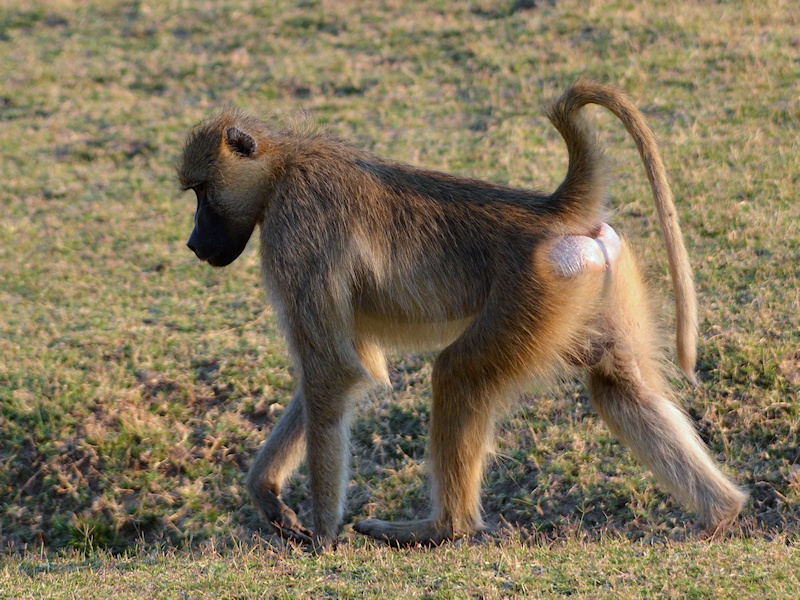
The yellow baboon, Papio cynocephalus, is one of five baboon species in Africa. Its range covers East Africa’s coastal and central zones—from southern Kenya through Tanzania and into Zambia and Malawi. The scientific name means “dog-headed” in Greek, referencing the elongated muzzle that all baboon species share. The common name refers to the yellow-brown coat that distinguishes it from the greener-toned olive baboon of highland areas.
An adult male yellow baboon weighs between 22 and 30 kilograms. Females are considerably lighter at 11 to 15 kilograms. The sexual size dimorphism is pronounced, as in all baboon species. Adult males develop large canine teeth and a pronounced shoulder mane. These features function primarily as intimidation displays in intra-male competition.
How It Differs From the Olive Baboon
The yellow baboon is more slender and long-limbed than the olive baboon. The coat is distinctly yellow-brown rather than the olive-green-grey of its relative. The face markings are slightly different — the muzzle is longer and the overall facial expression is sharper. Where the two species’ ranges meet in central Kenya and northern Tanzania, hybrids occur. The hybrid zone is well-documented, and the two species interbreed where they overlap.
Behaviorally, yellow baboons are slightly less bold than olive baboons in encounter situations with humans. This may reflect different histories of human contact in their respective ranges rather than genuine species-level behavioral differences. In fully habituated study populations, the social dynamics of yellow baboons mirror those of olive baboons in most respects.
Range and Habitat in Tanzania
In Tanzania, yellow baboons live across the miombo woodland belt; the coastal strip from Dar es Salaam northward; and Ruaha, Selous/Nyerere, Mikumi, and the Udzungwa Mountains. They are the dominant baboon species in the country’s south and east. Olive baboons replace them in the northwestern zone—the Serengeti, Ngorongoro, and areas bordering Uganda and Kenya’s highlands.
Mikumi National Park sits in ideal yellow baboon habitat at the transition between miombo woodland and open grassland. Large, habituated troops here provide excellent observation opportunities. Ruaha’s yellow baboon population is also substantial. Selous holds them along the Rufiji River banks and around the lake systems in the park’s northern section.
Social Structure and Behaviour
Yellow baboon troop structure mirrors that of other savanna baboon species. Multi-male, multi-female troops of 20 to 100 individuals operate under a dominance hierarchy in both sexes. Females are philopatric and form the stable core of the troop. Males transfer between troops throughout their adult lives. The same grooming politics, alliance formation, and male dominance competition that characterizes olive baboon troops operates in yellow baboon groups.
Yellow baboons sleep in trees or on cliff faces each night. Sleeping site selection prioritizes safety from terrestrial predators. Large fever trees, doum palms, and baobabs serve as preferred sleeping trees across the species’ range. A troop returns to the same sleeping trees repeatedly unless disturbed by a persistent predator or habitat change.
Conservation and Human Conflict
The yellow baboon is classified as Least Concern by the IUCN. Populations are stable and widespread. The species tolerates agricultural land well and persists in fragmented habitats near human settlement. This tolerance generates the same crop-raiding conflicts that affect olive baboon populations. In the coastal strip of Tanzania and in villages bordering Mikumi National Park, crop raids are a regular economic challenge for farming communities.
Plan Your Safari
Mikumi National Park is the most accessible yellow baboon destination in Tanzania. It sits on the main road between Dar es Salaam and the southern highland parks, making it practical for both short visits and extended stays. The park’s open plains hold large, habituated troops that are easy to observe from a vehicle. Tanzania’s Ruaha and Selous circuits give additional yellow baboon encounters alongside the southern parks’ exceptional predator populations.
African Wild Trekkers designs Tanzania southern circuit itineraries that include Mikumi, Ruaha, and Selous. Contact us to build a Tanzania safari that covers the full range of the country’s wildlife, not just the famous northern parks.