White Rhino Facts: Africa’s Square-Lipped Grazer and Conservation Success Story
At the end of the nineteenth century, fewer than 50 southern white rhinos remained alive. They had been hunted to the edge of extinction across southern Africa. Today, over 17,000 southern white rhinos live in protected areas and private land—the most successful large mammal conservation recovery in history. Understanding the white rhino means understanding both the animal and the extraordinary human effort that brought it back.
What Is the White Rhino?
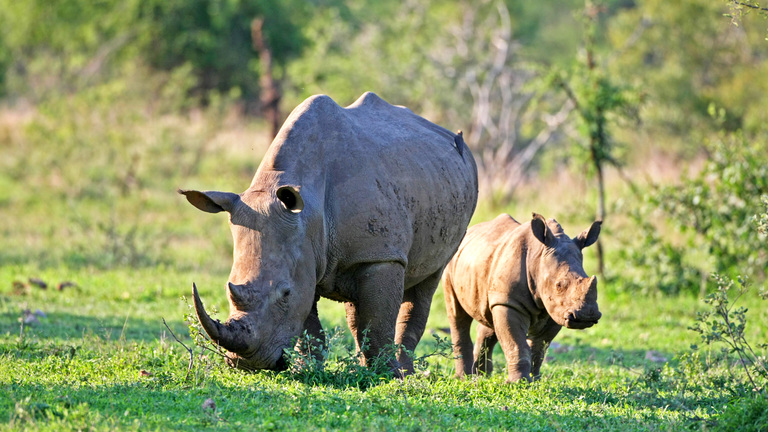
The white rhino, Ceratotherium simum, is the largest of the five living rhino species. The name “white” does not derive from the animal’s skin color—it is grey. The name most likely comes from the Afrikaans word “weit,” meaning wide, referring to the animal’s wide, flat, square upper lip. This lip shape is the primary physical distinction between the white rhino and the black rhino, whose lips are pointed and hook-shaped.
Two subspecies exist. The southern white rhino, Ceratotherium simum simum, is the abundant, conservation-recovered subspecies. The northern white rhino, Ceratotherium simum cottoni, is effectively extinct—only two females remain alive, both in Kenya’s Ol Pejeta Conservancy, sustained by assisted reproduction programs. The population figures for “white rhino” almost exclusively refer to the southern subspecies.
Physical Features and the Wide Lip
An adult male white rhino weighs between 2,000 and 2,500 kilograms. Females are lighter at 1,400 to 1,700 kilograms. The body is massive and barrel-shaped. Two horns grow from the nose—the front horn (anterior) is longer, sometimes exceeding 100 centimeters. The horns are made of keratin — the same protein as human fingernails — and grow continuously throughout the animal’s life.
The square lip is perfectly adapted to grazing short grass close to the ground. The white rhino is the only large African herbivore that mows grass as short as a livestock-grazed pasture. This grazing habit creates short-sward habitat that benefits a range of other species, including open-ground birds and smaller grazers that prefer short grass after larger animals have passed through.
Social Behaviour: Groups and Territories
White rhinos are more social than black rhinos. Female groups with calves are commonly observed. Adult bulls are territorial—they scent-mark dung middens, urine scrapes, and vegetation along territory boundaries. A dominant bull’s territory may span 1 to 3 square kilometers. Non-territorial bulls are tolerated within the territory provided they show submission—an unusual level of tolerance for rhinos, which are largely solitary in other species.
The characteristic submissive posture of a white rhino approaching a dominant bull is immediately recognizable in the field. The subordinate individual lowers its head and places its horn below the dominant animal’s chin. This low-head posture signals non-aggression. The dominant bull responds by pressing its horn downward against the submissive individual’s horn—a confirmation of relative rank without escalation to fighting.
White Rhinos in East Africa
Southern white rhinos are not native to East Africa. Their natural range is southern Africa. The population in Uganda’s Ziwa Rhino Sanctuary was established in 2005 with animals translocated from Kenya and the United States. This program has succeeded—the sanctuary now holds over 40 rhinos. Kenya’s Ol Pejeta Conservancy, Lake Nakuru National Park, and several private conservancies hold significant white rhino populations established through translocation from South Africa’s Hluhluwe-iMfolozi Park, the source population for most of the species’ recovery.
Conservation and Horn Poaching
The white rhino’s recovery has been repeatedly threatened by horn poaching. Rhino horn commands extremely high prices in Asian traditional medicine markets despite having no proven medicinal value. Poaching levels in South Africa surged from 2008 to 2018, killing thousands of rhinos in the species’ primary stronghold. Conservation responses include dehorning, intensive anti-poaching patrols, and community-based protection programs. The poaching curve has declined since 2018, but the pressure persists.
Plan Your Safari
Uganda’s Ziwa Rhino Sanctuary, north of Kampala, offers guided walking encounters with white rhinos at close range—one of very few places in Africa where you can walk with rhinos legally and safely. Kenya’s Ol Pejeta Conservancy and Lake Nakuru National Park offer vehicle-based encounters with large, habituated populations. Both countries’ rhino programs represent the best of African conservation efforts.
African Wild Trekkers includes Ziwa Rhino Sanctuary in Uganda itineraries and Ol Pejeta in Kenya circuits. Contact us to plan a safari that includes the full East African rhino experience.