Bongo Facts Africa: The Largest Forest Antelope
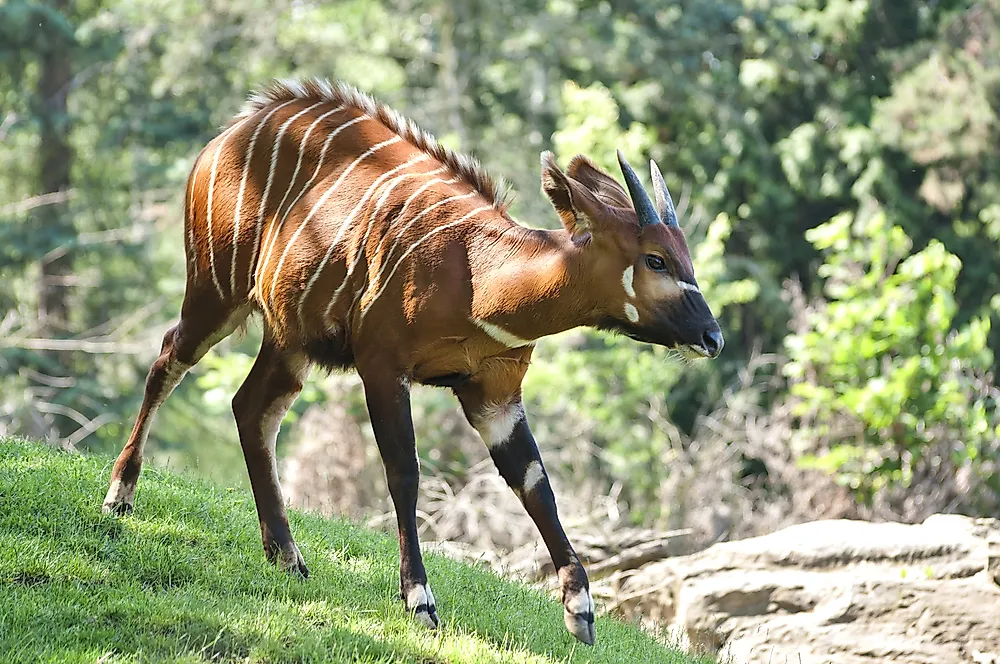
The bongo is the largest and most colourful of Africa’s forest antelopes. The body is bright chestnut-red. The coat carries 10 to 15 vertical white stripes on the flanks. The legs are dark with white horizontal bands. Both sexes carry spirally twisted horns. The bongo is as vivid as a tropical fish in a dark pond a blaze of orange and white in the dimly lit forest interior. And like a fish glimpsed between water plants, it vanishes before you can look at it properly.
What Is a Bongo?
The bongo, Tragelaphus eurycerus, belongs to the spiral-horned antelope group the same family as the kudu, eland, and bushbuck. Two subspecies exist. The western lowland bongo, found in the forests of West and Central Africa, is the more widespread. An adult male weighs between 240 and 405 kilograms making it the largest of all forest antelopes. Females weigh 210 to 235 kilograms.
Both sexes carry horns the only spiral-horned antelope species where females reliably carry substantial horns. The horns twist through a single open spiral, reaching 75 to 99 centimetres in males and slightly shorter in females. The tips are ivory-white. The horn shape and size make the bongo one of the most dramatic-looking antelopes in Africa when observed in good light.
Kenya’s Mountain Bongo: Critically Endangered
The eastern mountain bongo Kenya’s subspecies is among the rarest antelopes in Africa. Wild population estimates place it at fewer than 100 individuals, living in isolated forest patches on the Aberdare Mountains, Mount Kenya, and the Mau Forest. The subspecies declined catastrophically from the 1970s through the 1990s due to poaching, habitat loss, and disease introduced by domestic cattle.
A captive breeding and reintroduction programme has run since the 1990s animals bred in captivity in the United States were reintroduced to fenced sanctuaries in Kenya.
The Mountain Bongo Sanctuary within the Mount Kenya Wildlife Conservancy at Ol Pejeta and the Rhino Charge area of the Aberdare hold semi-wild populations that can be visited. Wild bongo sightings outside these managed areas are extremely rare.
Behaviour and Shyness
Bongo are among the shyest of East Africa’s large mammals. They detect human presence at long range and retreat into the deepest available forest cover. The white coat stripes which appear to advertise the animal’s presence against the reddish body actually function as concealment in forest light, where vertical striped patterns break up the body outline against a background of vertical tree trunks and shafts of filtered light.
Bongo are primarily nocturnal. They feed at dawn, dusk, and through the night. During the midday hours they rest in dense thicket. Their feeding includes leaves, flowers, bark, fruit, and the pith of plants a broad browser’s diet that allows them to sustain body condition in forest where no single food type is consistently abundant.
Ecological Role
The bongo creates tracks through dense forest that are used by many other forest species. Its large body weight compresses vegetation and clears movement corridors. It deposits dung that contributes to forest nutrient cycling. In forests where bongo have been extirpated, the absence of these large body disturbances contributes to denser understorey and altered plant community composition.
Plan Your Safari
The Mountain Bongo Sanctuary at Ol Pejeta Conservancy offers the most reliable bongo encounter in Kenya. The semi-wild animals there are partially habituated and can be viewed from vehicle or on foot within the fenced area. For a wild bongo experience, the Aberdare tree hotels where wild bongos occasionally visit illuminated waterhole areas at night offer the only realistic hope of a genuinely wild encounter. Dawn drives on the Aberdare’s forest tracks produce rare but possible sightings.
African Wild Trekkers includes Ol Pejeta Conservancy and the Aberdare in Kenya highland circuits. Contact us to plan a Kenya itinerary that targets this extraordinarily rare and beautiful antelope.