Tsessebe Facts Africa: The Fastest Antelope on the Continent
The tsessebe holds a record that surprises most safari visitors: it is the fastest antelope in Africa, capable of sustained speeds above 90 kilometers per hour. The cheetah may reach higher peak speeds, but the cheetah is a cat. Among antelopes, the tsessebe — with its odd downward-sloping back, large rounded head, and ungainly build — owns the speed record. Evolution optimized this animal for one specific strategy, not for photogenic elegance.
What Is a Tsessebe?
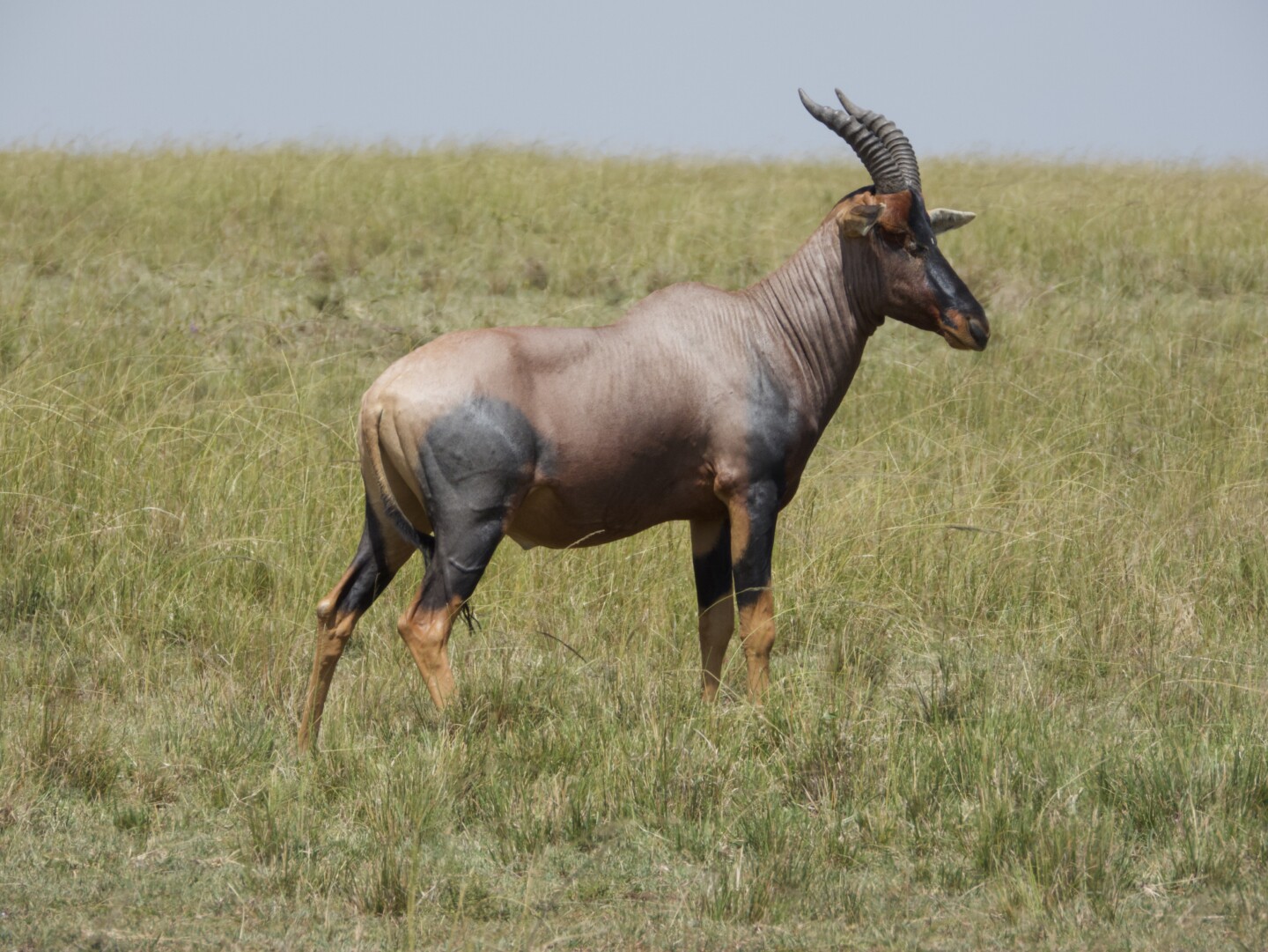
The tsessebe, Damaliscus lunatus lunatus, is a subspecies of the Damaliscus genus — a group that also includes the topi of Kenya and Uganda, Coke’s hartebeest, and the bontebok of South Africa. Adult males weigh between 136 and 168 kilograms. Females weigh 120 to 150 kilograms. Shoulder height reaches 1.2 meters. The shoulder sits distinctly higher than the hindquarters, creating the characteristic hunched profile visible at great distance. Both sexes carry S-shaped, lyre-curved horns reaching 37 to 40 centimeters.
The coat is rich reddish-brown with metallic iridescent highlights in good light—a purplish or blueish sheen over the shoulders and upper flanks. The face and upper limbs are darker, almost blackish. Up close, the tsessebe is one of the more handsome large antelopes despite the ungainly profile.
The Speed Strategy
Speed is the tsessebe’s primary predator defense. It sustains speeds above 70 kilometers per hour for extended periods and reaches 90 kilometers per hour in short bursts. No African predator can run it down in a sustained chase. Even the cheetah—faster at peak speed—cannot maintain its sprint long enough to catch a tsessebe already in full flight. The energy cost of accelerating 150 kilograms to 90 kilometers per hour is extraordinary, but the predator avoidance value justifies it fully.
Speed defense demands open terrain. Tsessebe are open-country specialists—open savanna, floodplain grassland, and open woodland where sustained running is possible. A dense bush does not suit them. This habitat requirement pushes their distribution toward the same open ecosystems occupied by wildebeest, hartebeest, and topi, all of which often co-occur with them.
Territorial Behavior
Male tsessebe hold territories during the breeding season. A territorial male chooses a prominent termite mound, tree stump, or raised ground and stands on it conspicuously—a behavior called lording. From this elevated position he surveys his territory, displays to rival males, and advertises his presence to females. The mound makes him visible from far greater distances than ground level would allow in open grassland.
Female herds move through multiple male territories. Reproductive success depends on a male’s ability to retain females within his territory long enough to mate. This dynamic creates intense competition for territories adjacent to quality grazing areas where female herds concentrate naturally.
Range in East Africa
The tsessebe’s core range lies in Zimbabwe, Botswana, and Zambia. In East Africa proper, Uganda’s Queen Elizabeth National Park and the Albertine Rift open zones support a population. Rwanda’s Akagera National Park holds a small introduced herd. In Kenya and Tanzania, the closely related topi replaces the tsessebe. Where both potentially occur, range is a more reliable field identification guide than physical features.
Plan Your Safari
Uganda’s Queen Elizabeth National Park is the most accessible East Africa location for tsessebe. The Ishasha and Mweya peninsula open grasslands produce sightings alongside topi, Uganda kob, and warthog on the same drives. Rwanda’s Akagera open savanna zone offers a small herd visible on game drives through the park’s northern sector.
African Wild Trekkers includes Queen Elizabeth and Akagera in Uganda and Rwanda safari itineraries. Contact us to plan an itinerary capturing the Albertine Rift’s distinctive antelope assemblage.