Large Spotted Genet Facts: The Cat-Like Climber of East Africa’s Forests
Sit on a safari lodge veranda in East Africa after dark, and sooner or later a slender, spotted animal with a long banded tail appears on a branch or railing overhead. The large spotted genet visits outdoor dining areas because they attract rodents and insects — and rodents and insects are what it eats. Understanding this beautiful, ancient mammal requires knowing not just what it eats but what it is. The answer is older and stranger than most visitors expect.
What Is a Large Spotted Genet?
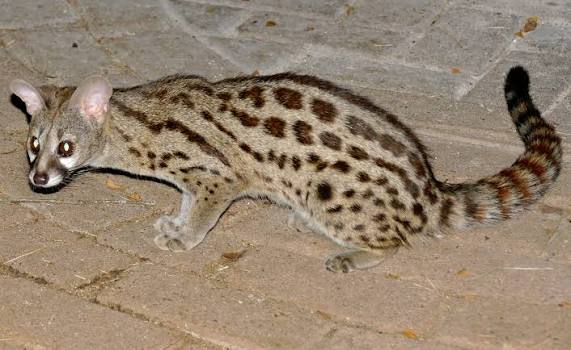
The large spotted genet, Genetta tigrina, belongs to the family Viverridae — the civets and genets. Genets diverged from other carnivore lineages over 50 million years ago. They represent the closest living equivalent to the ancestral carnivorans from which cats, dogs, bears, weasels, and mongooses all descended. Adults weigh between 1.5 and 3.2 kilograms. Body length reaches 42 to 57 centimetres with a tail of 40 to 51 centimetres — nearly as long as the body. Pale grey fur carries large dark brown or black spots in rows. The tail displays alternating dark and pale bands. A pointed muzzle and large, mobile ears complete the profile.
At first glance the genet resembles a cat — spotted coat, retractile claws, similar hunting technique. The resemblance reflects convergent evolution, not shared ancestry. Genets are not closely related to cats. Both lineages independently evolved solutions to the same challenge: catching small prey in dense vegetation at night.
Arboreal Hunting
Genets are fully arboreal hunters. They pursue prey through trees and along branches with the same fluid, controlled movement cats show on the ground. Roosting birds, small mammals up to squirrel-size, lizards, frogs, and large insects all fall to them. A long body and flexible spine let them navigate narrow branches and squeeze into tree trunk cavities. Semi-retractile claws grip bark with precision. The long tail provides balance on narrow perches.
Ground hunts follow the same ambush sequence as small cats — slow, precise stalking to within one body length of the prey, then a rapid pounce. Rodents dominate the ground-level diet. The genet kills with a precise bite to the back of the skull — a technique shared with many mustelids and the domestic cat.
Territorial Communication
Genets maintain home ranges and mark them with glandular secretions deposited on branches and rocks along regular routes. The perineal gland secretion dominates the scent-marking system. Both sexes hold territories. Males maintain larger ranges that overlap with multiple female territories — a mating access system based on range overlap rather than direct mate defence, mirroring the territory systems of leopards and servals.
Range and Habitat in East Africa
The large spotted genet occupies a wide range of East African habitats — forest, woodland, savanna margins, coastal scrub, and lodge gardens. Some tree cover is necessary, but the genet adapts readily to human-modified landscapes where food is adequate. This adaptability makes it one of East Africa’s most successful small carnivores in the modern landscape.
Plan Your Safari
Lodge verandas and outdoor dining areas after dark offer the most reliable large spotted genet encounters in East Africa. Most Kenya and Tanzania safari lodges with outdoor dining host regular genet visits. Active spotlighting on night drives through woodland and forest margins also produces sightings. The Aberdare tree hotels attract genets to illuminated waterhole areas alongside the larger nocturnal mammals. A genet silhouetted on the viewing platform fence rail — slender body and banded tail catching the light — is usually the most elegant small mammal of any Aberdare night.
African Wild Trekkers selects safari accommodations with strong nocturnal wildlife programmes. Contact us to plan an East Africa safari capturing the full cast of the night’s wildlife alongside the day’s.