Aardwolf Facts Africa: The Termite-Eating Hyena of East Africa’s Dry Plains
The aardwolf belongs to the hyena family. Its closest relatives are the spotted hyena, the brown hyena, and the striped hyena. It looks like a miniature hyena with a pointed muzzle and five toes on its forefeet rather than four. But it does not eat carcasses. It does not kill mammals. It lacks the crushing jaw musculature that defines its family. The aardwolf eats termites — specifically the harvester termites of the genus Trinervitermes that surface-forage on dry savanna at night. Roughly 300,000 termites disappear per night into an aardwolf’s stomach. Understanding the aardwolf means abandoning everything you know about hyenas.
What Is an Aardwolf?
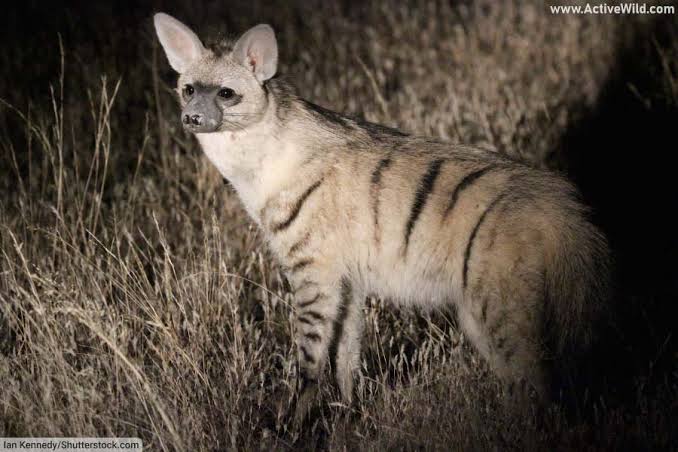
The aardwolf, Proteles cristata, is the sole member of its genus. Its name means “earth wolf” in Afrikaans — a reference to burrowing behaviour. Adults weigh between 8 and 14 kilograms. Body length reaches 55 to 80 centimetres with a tail of 20 to 30 centimetres. Pale tawny-yellow fur carries several vertical black stripes on the flanks. A dorsal mane of long, black-tipped hair runs from neck to tail base — when alarmed, this mane erects fully, doubling the apparent body height. The spotted and brown hyenas show the same threat-mane response.
Small jaws and teeth reduced to simple pegs sit entirely inadequate for the crushing function of true hyena dentition. A wide, flat tongue covered in thick, sticky mucus serves as the termite-harvesting organ. Five-toed forefeet retain a vestigial fifth toe that true hyenas lost — evidence of the aardwolf’s earlier divergence from the common hyena ancestor.
The Trinervitermes Termite Specialist
Trinervitermes termites — a genus of harvester termites of the drier savannas — make up almost the entire aardwolf diet. These termites surface-forage in columns at night, harvesting dead grass and carrying it underground. An aardwolf locates a harvesting column by smell, laps up the termites with rapid tongue strokes, and moves on to the next column. A single individual consumes 200,000 to 300,000 termites in one night’s foraging.
This termite specialisation shaped the entire aardwolf anatomy. A broad, sticky tongue. Small jaws and reduced teeth — larger ones would interfere with tongue movement. A foraging range that tracks Trinervitermes distribution exactly. Seasonal movement adjustments where termite surface activity varies. Every feature is a consequence of committing fully to one abundant, widely distributed food source.
Nocturnal and Rarely Seen
The aardwolf is strictly nocturnal. Daytime rest occurs in borrowed burrows — most often those of aardvarks. After dark it forages along predictable routes within its home range and returns before dawn. Night drives in appropriate habitat are the only reliable way to encounter one.
Eye-shine is pale yellow-green, visible from 50 to 70 metres in a spotlight. On spotlight contact, the aardwolf typically pauses, assesses, and trots away at an angle — giving a brief but clear view of striped flanks and semi-erected mane. Sightings are less frequent than those of most other nocturnal mammals of similar size.
Range in East Africa
Aardwolves occupy the drier savannas of East Africa — Kenya’s dry northern and central zones, Tanzania’s miombo woodland margins, and parts of Uganda’s drier north. Dense forest and moist grassland where Trinervitermes is replaced by other termite genera lie outside their range. In Kenya, the Laikipia Plateau, Samburu, and the Rift Valley dry grasslands produce sightings. Tanzania’s Serengeti dry season plains and the Ngorongoro highlands both hold populations.
Plan Your Safari
The Ngorongoro Conservation Area and the Serengeti’s open plains produce the most reliable aardwolf encounters in East Africa. Night drives from lodges inside the conservation area yield regular sightings in drier grassland zones. Kenya’s Laikipia conservancies — particularly those offering dedicated night drive programmes — are also productive. A handheld spotlight held at ground level, searching specifically for the small striped shape of a foraging aardwolf, is far more effective than fast night driving.
African Wild Trekkers includes night drive programmes in East Africa safari itineraries where available. Contact us to plan a safari targeting East Africa’s extraordinary and rarely seen nocturnal mammals.