De Brazza Monkey: The Swamp Forest Primate of East and Central Africa
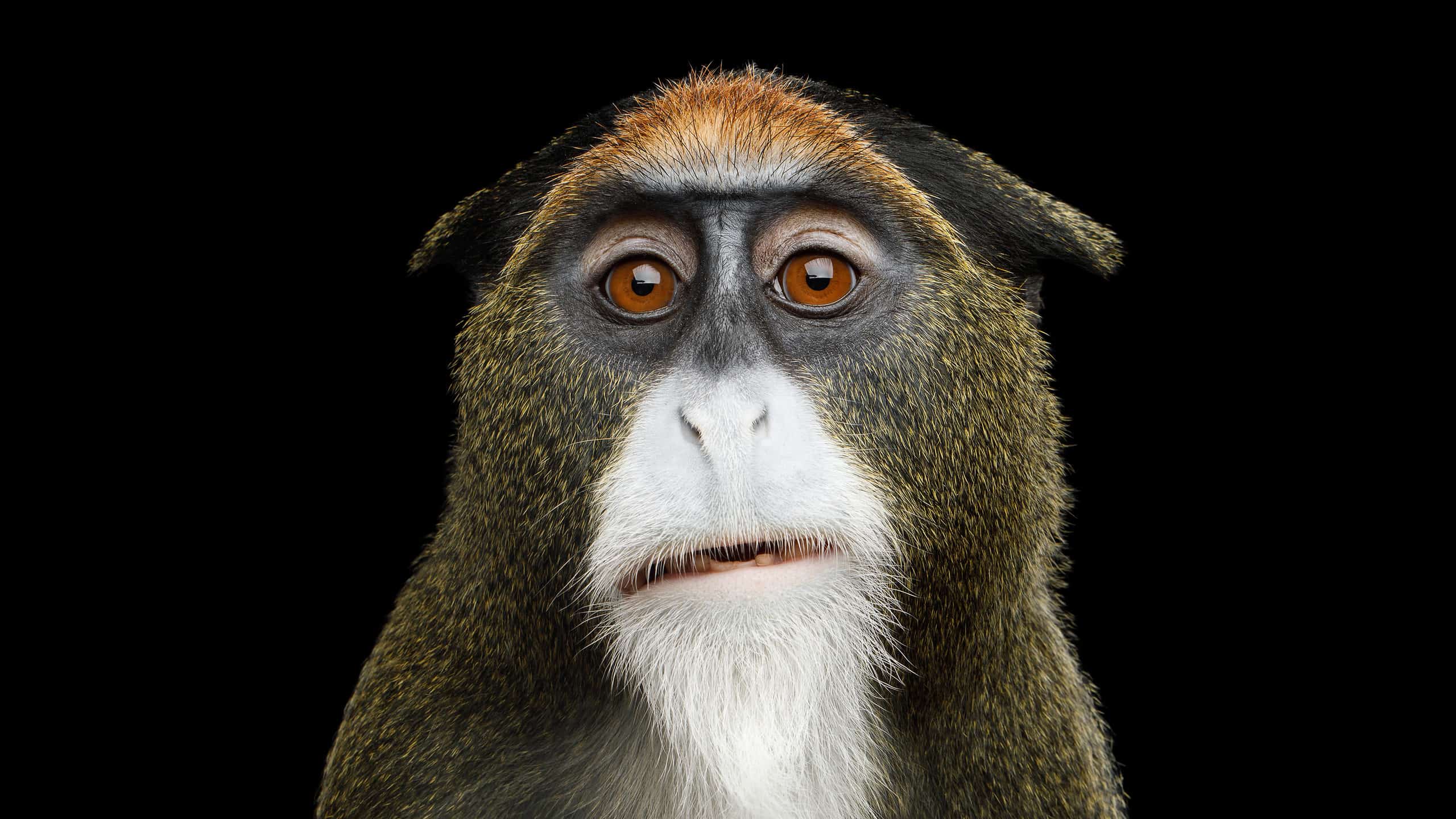
The De Brazza’s monkey looks like it’s dressed for a formal occasion. A white beard. An orange crescent across the forehead. A blue face with a reddish tinge around the eyes. No other forest primate in East Africa carries this combination of facial markings. The De Brazza’s monkey is unmistakable when seen, but it does everything in its power to avoid being seen at all.
What Is the De Brazza Monkey?
The De Brazza monkey, Cercopithecus neglectus, is a guenon species named after the French-Italian explorer Pierre Savorgnan de Brazza. The species name “neglectus”—meaning “neglected” in Latin—refers to how little scientific attention it received in its early description. An adult male weighs between 7 and 9 kilograms. Females are lighter at 4 to 5 kilograms.
The species has an unusually wide distribution for a primate so closely tied to a specialist habitat. It ranges from Cameroon east through the Congo Basin and into Uganda, South Sudan, Ethiopia, and Kenya. Throughout this range it occupies the same habitat type: dense swamp forest, riverine gallery forest, and flooded woodland adjacent to permanent water.
Physical Features: The White Beard and Blue Face
The De Brazza monkey’s facial markings are unique in the primate world. The white beard extends from chin to chest in adult males. It is smaller in females and absent in juveniles. The orange diadem—a crescent-shaped band of orange or yellow hair—arches across the forehead just above the brow line. The face itself is blue-grey with pink skin around the eyes, giving a reddish orbital ring.
The body coat is grey-olive above and white below. The scrotum of adult males is bright blue—a color shared with several other guenon species and used in visual displays during male-male competition. The limbs are moderate in length. The overall body shape is more compact than most guenons, suited to movement through dense waterside vegetation.
Swamp and Riverine Forest Habitat
The De Brazza monkey’s habitat specialization is its most defining ecological feature. It lives in forests directly associated with permanent water. Papyrus swamps, seasonally flooded woodland, gallery forest along rivers, and forest on islands within rivers all serve as primary habitat. The monkey rarely moves far from water and retreats into the densest waterside vegetation when disturbed.
This water association provides specific advantages. Riverine and swamp forests are among the most productive forest types in terms of fruit availability. They also provide escape routes. A threatened De Brazza monkey drops from vegetation into water and swims to avoid terrestrial predators. It is a capable swimmer and uses water deliberately as a predator avoidance strategy—unusual behavior among forest monkeys.
Social Life: Small and Secretive Groups
De Brazza monkeys live in small family groups of 2 to 10 individuals. The typical group consists of one adult male, one or two adult females, and their offspring. This small group size combined with cryptic habitat and extremely quiet behavior makes De Brazza monkeys the hardest of Uganda’s forest monkeys to detect in the field.
When alarmed, the group freezes completely. Individuals press against tree trunks or crouch on branches and remain motionless for minutes at a time. This freeze response confuses predators that rely on movement detection. It also confuses researchers and safari visitors. Groups of De Brazza monkeys remain invisible within meters of observers who do not specifically know where to look.
Range in Uganda and East Africa
In Uganda, the De Brazza monkey lives in the Semuliki Forest, the wetlands bordering Lake Albert, and in riparian forest strips along the Semuliki River. The Semuliki National Park is the most reliable location in Uganda for De Brazza monkey encounters. Kenya holds small populations in the Saiwa Swamp National Park near Kitale—one of the few national parks in Kenya created specifically to protect the habitat of a single mammal species.
Plan Your Safari
Saiwa Swamp National Park in western Kenya is the most accessible De Brazza monkey site in East Africa. The park is small, walk-only, and designed around De Brazza monkey and sitatunga viewing from elevated platforms above the swamp. Uganda’s Semuliki National Park provides a wilder, more challenging encounter in a genuine swamp forest. Both require patience and good guiding to produce sightings.
African Wild Trekkers includes Saiwa Swamp and Uganda’s Semuliki Valley in specialist itineraries for visitors targeting East Africa’s lesser-known primates. Contact us to design a trip that reaches beyond the famous destinations.