Honey Badger Africa: The Fearless Omnivore That Defies Every Predator
The honey badger holds a Guinness World Record — the world’s most fearless animal. That record reflects something genuine. A honey badger will charge a lion. It will attack a cobra. It will raid a beehive and absorb thousands of stings without retreating. No animal its size in Africa takes on threats with the same reckless confidence. Understanding the honey badger means understanding an animal that evolution equipped with near-total physical invulnerability at small scale — and that has built an entire lifestyle around that invulnerability.
What Is a Honey Badger?
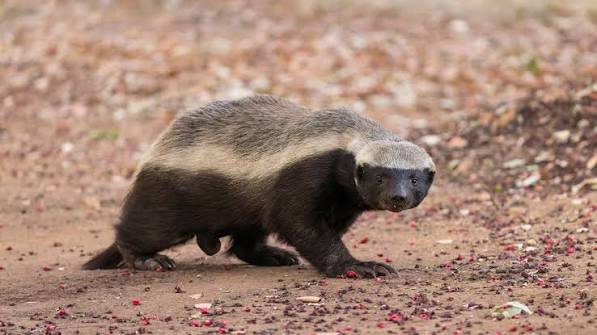
The honey badger, Mellivora capensis, belongs to the family Mustelidae the same family as otters, weasels, and wolverines. Adults weigh between 6 and 14 kilograms. Body length reaches 55 to 77 centimetres with a tail of 12 to 30 centimetres. The build is stocky and low-slung powerful shoulders, short strong legs, and long digging claws on the forefeet. The coat divides sharply into two zones: white or silver-grey on the top of the head, neck, and back, and jet black on the face, sides, and underparts. This two-tone colouration is a warning pattern aposematic colouration signalling to predators that this animal is not worth attacking.
The skin is the key to the honey badger’s fearlessness. It is extraordinarily thick up to 6 millimetres on the neck and remarkably loose. A predator gripping the honey badger’s scruff finds that the skin rotates freely, allowing the honey badger to turn around inside its own skin and bite the predator’s face. Snake fangs, bee stings, and porcupine quills penetrate with difficulty. This combination of thick, loose, rubbery skin and natural resistance to many venoms makes the honey badger one of the hardest small mammals in the world to kill.
Diet: The Original Omnivore
The honey badger eats almost anything. Documented food items include venomous snakes, scorpions, bee larvae and honey, rodents, birds, eggs, tortoises, lizards, frogs, insects, carrion, fruits, and roots. Venomous snakes are a genuine dietary speciality. Puff adders, cobras, and mambas all appear in the diet. Resistance to venom through modified acetylcholine receptors in the nervous system the same genetic change that protects mongooses allows it to survive bites that would kill animals many times its size.
Bee colony raiding gives the honey badger its name. Thick skin protects against stings. Powerful digging claws break open wild bee nests in trees and termite mounds. The honeyguide bird a species that actively leads honey badgers to bee nests through a distinctive call and flight pattern guides the badger to colonies it may not have located alone. The honeyguide then feeds on the exposed larvae and wax after the honey badger breaks the colony open.
Fearless Defence: How It Works in Practice
When a lion, leopard, or hyena confronts a honey badger, the badger’s response is aggression rather than flight. It faces the predator, erects the fur along its back, and advances. The anal gland produces a powerful, nauseating secretion during threat encounters. Most predators disengage quickly. A young lion or leopard that grips a honey badger faces a writhing, biting mass that turns inside its own skin and latches onto the face or foot with extremely strong jaws. Very few predators persist long enough to kill one.
Range and Habitat in East Africa
The honey badger occupies a vast range from sub-Saharan Africa through the Middle East to India. In East Africa it appears in nearly every habitat: savanna, woodland, forest margins, rocky terrain, semi-arid scrub, and agricultural land. No habitat requirement restricts it significantly sufficient food and the ability to dig or find shelter is enough. Nocturnal and crepuscular, it is most active after dark and before dawn. Night drives in any East Africa national park with a night drive programme produce honey badger sightings.
Plan Your Safari
Kenya’s Laikipia Plateau conservancies produce the most reliable honey badger encounters in East Africa. Several Laikipia properties have habituated individual honey badgers that visit camp at night and allow close vehicle approach. Tanzania’s Serengeti and the Ngorongoro Conservation Area produce night drive sightings regularly. In Uganda, Queen Elizabeth and Murchison Falls night drives encounter honey badgers on foraging routes near waterholes. A deliberate, slow night drive with a good spotlight and a guide scanning low to the ground produces far more sightings than fast driving.
African Wild Trekkers designs East Africa safari itineraries that include night drive programmes in the best small carnivore habitats. Contact us to plan a safari that reveals the honey badger alongside East Africa’s larger nocturnal wildlife.