Gerenuk Facts Africa: The Giraffe-Necked Antelope of Kenya’s Dry Country
The gerenuk stands upright on its hindlegs to browse. No other antelope does this routinely. A gerenuk standing on two legs to reach browse at 2 metres, its impossibly long neck extended fully upward, looks like an animal assembled from the wrong body parts. The elongated neck, long slender legs, small head, and very large eyes together suggest an animal that evolution pushed toward a single extreme specialisation feeding at heights no competing browser of similar body mass can reach. Kenya’s dry-country circuit is the place to find it, and watching a gerenuk feed is one of East Africa’s most distinctive wildlife encounters.
What Is a Gerenuk?
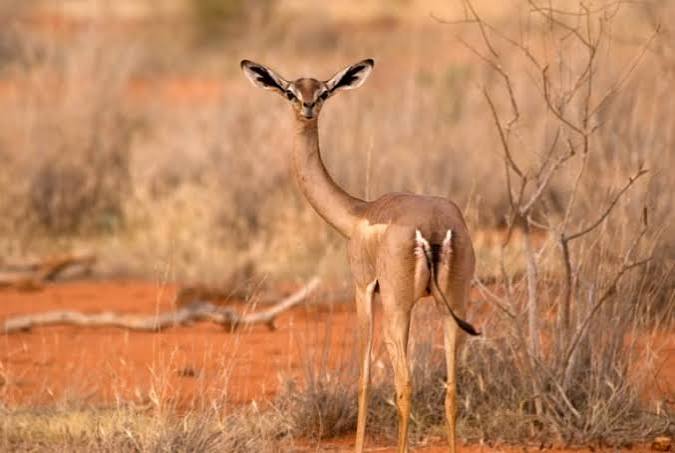
The gerenuk, Litocranius walleri, belongs to the gazelle team. Its name comes from the Somali word for giraffe-necked. Adults weigh between 28 and 52 kilograms. Shoulder height reaches 80 to 105 centimetres. Only males carry horns S-curved and heavily ridged, reaching 31 to 44 centimetres. The neck is disproportionately long relative to the body far longer than any other gazelle species. The coat is reddish-brown on the back and sides with pale underparts. The face is long and slender with very large dark eyes and large mobile ears. A dark patch runs from the eye to the corner of the mouth.
The hindquarters show a distinctive muscular development in the upper hindlegs the muscles that lock the hindlegs straight during bipedal feeding. The forelegs are long and thin. When a gerenuk stands upright, it hooks the inner surface of the foreleg around a branch to stabilise itself, freeing the long neck and prehensile upper lip to strip leaves from high branches.
Bipedal Feeding: The Gerenuk’s Defining Behaviour
Gerenuks feed from ground level to 2 metres by switching between quadrupedal and bipedal postures. Lower browse feeds while standing on all fours. For browse above 1.4 metres, the gerenuk rises onto its hindlegs, locks its hindleg joints, hooks the forelegs around the stem, extends the neck fully, and strips leaves with the long, prehensile upper lip. This posture holds for minutes at a time the hip and knee joints lock in extension, reducing muscular effort during sustained bipedal feeding.
This feeding height advantage excludes competing browsers. Impala reach 1.2 metres on four legs. Dik-dik feeds below 0.8 metres. The gerenuk occupies the 1.2 to 2 metre browse zone almost exclusively in the dry-country scrub where all three species co-exist. Competition for food is minimal because the feeding niche is distinct.
Water Independence
Gerenuks do not drink water. They extract sufficient moisture from the leaves, shoots, flowers, and fruit they consume. This complete water independence allows them to persist in extremely arid habitats where no permanent or seasonal surface water exists. The arid Acacia-Commiphora scrub of northern Kenya one of the driest wildlife landscapes in East Africa is the gerenuk’s stronghold precisely because water independence gives it an advantage over water-dependent competitors.
Range in East Africa
The gerenuk’s range centres on northern and northeastern Kenya Samburu, Buffalo Springs, Shaba, Tsavo East, and the dry zones of the Laikipia Plateau. Southern Ethiopia and Somalia extend the range northward. Tanzania holds a small population in the Serengeti’s north and in the dry northwest. The species requires dense Acacia-Commiphora scrub with browse available at the bipedal feeding height. Open grassland and very dense forest both fall outside its range.
Plan Your Safari
Samburu National Reserve is the finest gerenuk location in East Africa. The reserve’s dense Acacia-Commiphora scrub along the Ewaso Nyiro River holds resident gerenuk groups visible on every game drive. Watching a female or male gerenuk rise onto its hindlegs and browse from a 2-metre Acacia from a vehicle parked 10 metres away is one of Kenya’s most distinctive wildlife moments. Buffalo Springs and Shaba National Reserves, adjacent to Samburu, add variety of terrain and additional gerenuk encounters to a northern Kenya circuit.
African Wild Trekkers designs northern Kenya safari circuits centred on Samburu and its extraordinary dry-country specialist fauna. Contact us to plan a Kenya itinerary that includes the north’s unique wildlife alongside the Maasai Mara.