Pin-tailed Whydah: East Africa’s Most Dramatic Small Bird Display
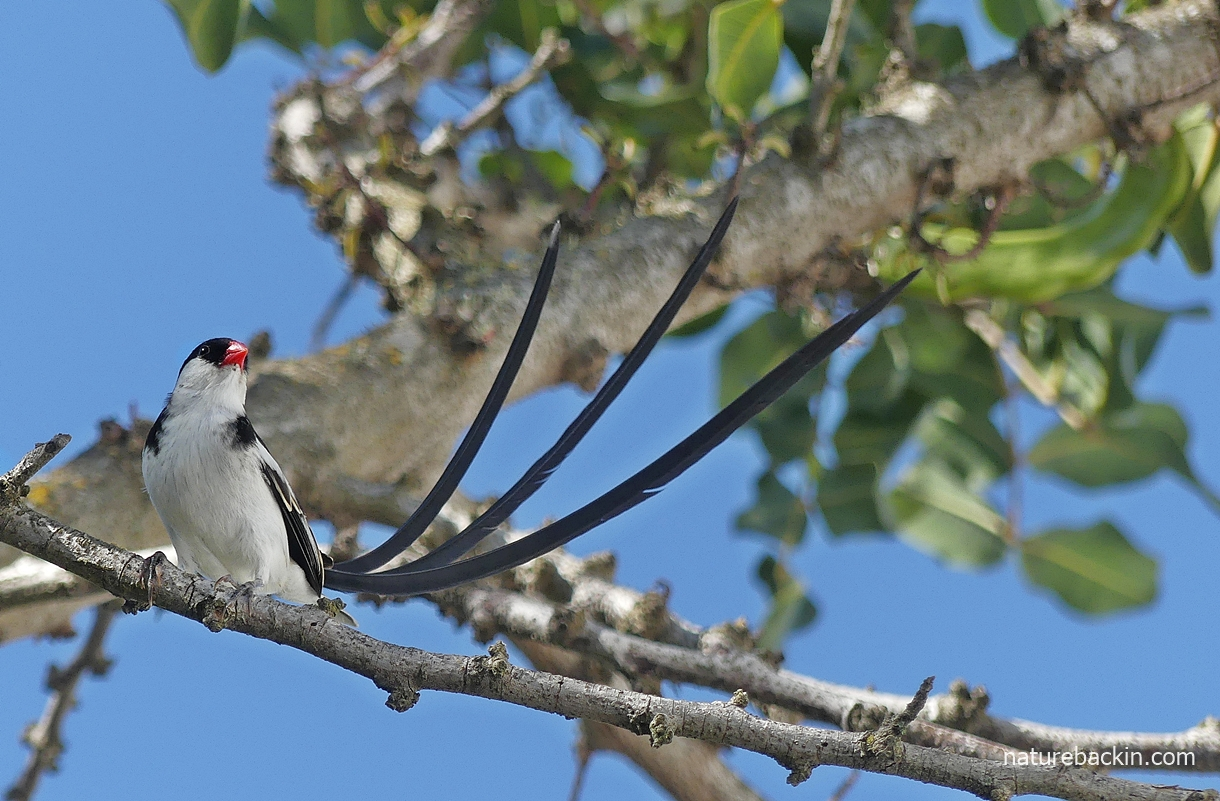
The breeding male pin-tailed whydah is one of East Africa’s most immediately striking small birds. In full breeding plumage, he carries four elongated central tail feathers that extend to 20 centimeters behind the body—more than twice the bird’s body length. The tail feathers bounce and flutter during the male’s aerial display over the territories of female waxbills. This display is one of the most dramatic in Africa’s small bird community and is visible from considerable distances across open savanna and garden habitats.
Outside the breeding season, the male loses his long tail feathers and becomes a much more modest streaked brown bird indistinguishable at a glance from a female or immature individual. The contrast between the brilliant breeding male with his extended tail and the drab non-breeding male is one of the most extreme seasonal plumage changes of any small bird in Africa.
Identification of Breeding Male
The breeding male pin-tailed whydah shows a black head and upperparts with a pure white collar and white underparts. The bill is vivid red. The four elongated central tail feathers are black and trail behind the bird in a distinctive streamer that is visible even in brief flight views.
The long tail creates significant aerodynamic resistance during flight. The male compensates with a distinctive bounding, undulating flight pattern that allows the tail to lift on each upward bound and trail behind on each descent. This characteristic flight silhouette is immediately recognizable and identifies the breeding male at distances where plumage color and detail are not clearly visible.
Non-breeding males and females show streaked brown and white plumage typical of many waxbill species. The red bill is retained throughout the year in adults of both sexes and provides the most reliable feature for distinguishing non-breeding whydahs from the many other streaked small birds that share their habitat.
Brood Parasite Relationship
The pin-tailed whydah is a brood parasite that lays its eggs exclusively in the nests of common waxbills. The whydah chick mimics the mouth markings and the begging calls of the common waxbill chick with sufficient accuracy to be accepted and fed by the host parents throughout the nestling period.
The male pin-tailed whydah actively associates with female common waxbills rather than with females of his own species during territory establishment. He monitors waxbill nesting activity closely during the egg-laying period. The female whydah deposits her eggs in active waxbill nests when both host parents are temporarily absent.
Furthermore, the whydah does not harm the host chicks in the nest. Unlike the cuckoo family’s brood parasites, the whydah chick grows up alongside the host chicks, and the host parents raise all the chicks together. The cost to the hosts is the additional food demand rather than the death of their own chicks.
Distribution and Where to See Pin-tailed Whydahs
Pin-tailed whydahs are common across East Africa wherever common waxbills provide sufficient host nests. The species inhabits open grassland, garden edges, cultivated areas, and bushed grassland from sea level to about 2,000 meters altitude.
Breeding males are most visible and most dramatically plumaged between October and April during the long breeding season. Any garden or open grassy area in East Africa during this period has the potential to hold displaying males visible from a distance over the territory they are defending and displaying within.
Kenya’s open savanna areas, Tanzania’s woodland edges, and Uganda’s garden environments all carry pin-tailed whydah populations. The species is common in the suburban areas of Nairobi, Kampala, and Arusha, where weedy gardens and grass verges provide both food and host nest opportunities.
Plan Your Birding Safari
Pin-tailed whydah sightings require no specialist effort during the breeding season. Displaying males are visible from moving vehicles on roads through open savanna habitat and from camp gardens across East Africa during the October-to-April period.
The most memorable encounters occur when a breeding male lands at close range on a roadside grass stem with his tail feathers streaming behind him. This image captures the extraordinary excess of the breeding display in a way that aerial sightings do not fully convey.
African Wild Trekkers designs East Africa safari itineraries that capture the seasonal highlights of the region’s small bird community. Contact us to plan a safari timed to witness East Africa’s most dramatic small bird breeding displays.