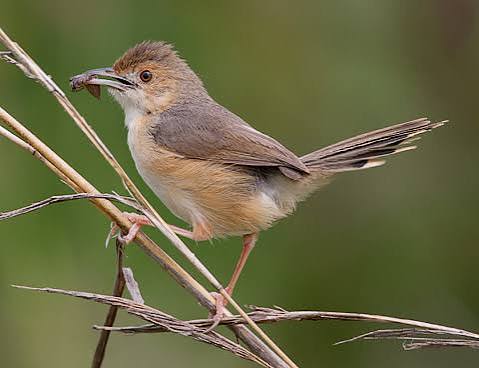
Red-faced Cisticola: The Riverside Warbler With a Distinctive Rufous Face
The red-faced cisticola is one of East Africa’s most distinctive cisticola species. The rufous-orange wash on the face and lores gives the species its name and provides a reliable identification feature that distinguishes it from the many other cisticola species that show plain or streaked faces. The species inhabits riverine vegetation, the edges of papyrus swamps, and dense waterside herbage — a specific habitat combination that limits its distribution but makes it predictable at appropriate sites.
Finding the red-faced cisticola rewards birders who take the time to move slowly along riverbank vegetation and listen carefully for the species’ distinctive call. The bird is secretive within the dense waterside vegetation it prefers. However, it calls frequently and the call provides the most reliable initial detection method before the bird is seen.
Identification
The red-faced cisticola shows warm rufous-orange on the face, lores, and supercilium that immediately separates it from the majority of East African cisticola species. The upperparts are streaked brown and rufous in the typical cisticola pattern. The underparts are pale buff with slightly darker flanks. The tail is relatively long for a cisticola and shows rufous tones on the outer feathers.
The rufous face distinguishes the species from the zitting cisticola, which shows a similar streaked brown upperpart pattern but lacks the rufous face wash. The red-faced cisticola is also larger than the zitting cisticola, which is the smallest East African cisticola species. This size difference is apparent in direct comparison but less obvious when the two species are seen separately.
The bill is slender and slightly down-curved at the tip in the typical cisticola pattern. The legs are pale pink. These structural features place the bird firmly within the cisticola family even when the rufous face is not clearly visible from a specific observation angle.
Song and Call
The red-faced cisticola’s song is a series of clear, descending whistled notes repeated at regular intervals. The song carries well across open water and through riverine vegetation. It is distinctive enough from other riverside cisticola songs to serve as a reliable identification feature for observers who have learned it by comparison with similar species.
The alarm call is a sharp, scolding “chek” note repeated rapidly. This call is given when the bird detects an observer or a predator at close range. The alarm call often draws the bird toward the intruder to assess the threat. This approach behaviour provides the best observation opportunity for a species that otherwise stays within the vegetation.
Males sing persistently from elevated positions within the waterside vegetation during the breeding season. The singing male regularly shows itself at the top of a reed or papyrus stem for brief periods during each song bout. These brief appearances at the exposed stem top are the primary visual observation windows for a species that rarely perches fully in the open.
Habitat and Distribution
The red-faced cisticola inhabits the edges of rivers, streams, papyrus margins, and any area of dense waterside vegetation in East Africa. It requires taller, denser vegetation than the open grassland cisticola species and is absent from short grassland and open marsh environments without sufficient tall vegetation cover.
The species is present throughout East Africa’s river and wetland systems from sea level to approximately 1,800 metres altitude. Uganda’s Nile River wetlands, Kenya’s Tana River riparian zone, and Tanzania’s river systems in both the northern and southern circuit areas all carry red-faced cisticola populations.
Furthermore, the species is found around the margins of East Africa’s Rift Valley lakes wherever tall waterside vegetation grows. Lake Naivasha’s papyrus margins, Lake Baringo’s reed beds, and the Kazinga Channel’s papyrus fringes in Uganda all provide accessible red-faced cisticola habitat within established safari circuits.
Where to Find Red-faced Cisticolas
The most productive approach for red-faced cisticola sightings is a slow walk along riverbank vegetation in the early morning when the species is most vocal. The bird calls from within the vegetation throughout the morning and shows itself briefly at stem tops during singing bouts. Patience and quiet movement produce far better sighting quality than quick, noisy approaches to the riverbank.
Uganda’s Bigodi Wetland and the papyrus margins of Queen Elizabeth National Park’s Kazinga Channel carry accessible red-faced cisticola populations. Any birding walk that follows the wetland edge closely at these sites will encounter the species through its call within the first 30 minutes of searching.
Kenya’s Lake Naivasha provides a productive red-faced cisticola environment in the papyrus strips bordering the lake’s open water. The species calls frequently from the papyrus edge and often shows itself at the top of papyrus stems within 5 metres of a quiet observer positioned at the water’s edge.
Plan Your Birding Safari
Red-faced cisticola sightings require wetland and riverside destinations with tall vegetation margins. Uganda’s Kazinga Channel boat trip and walking activities at Bigodi Wetland both provide reliable encounters. Kenya’s Naivasha lake shore birding produces the species as a standard component of a morning walk along the papyrus edge.
Learning the species’ song before visiting the site allows initial detection by sound. This advance preparation dramatically improves the efficiency of any cisticola search in dense waterside vegetation where visual scanning alone misses the majority of calling birds.
African Wild Trekkers includes wetland birding walks in East Africa safari itineraries for guests interested in the region’s grassland and wetland warbler diversity. Contact us to plan a safari that explores the full range of East Africa’s extraordinary cisticola community.