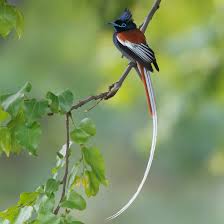
African Paradise Flycatcher: East Africa’s Most Elegant Long-tailed Forest Bird
The African paradise flycatcher is one of East Africa’s most graceful birds. The male carries two elongated central tail feathers that stream 15 to 20 centimetres behind the body, creating a flowing tail that trails behind every turn and hover in the forest understorey. The combination of this spectacular tail, the vivid blue orbital ring around the eye, and the rufous-orange and grey body plumage makes the male paradise flycatcher a defining image of East African forest and woodland birding.
The species is common across a wide range of forest, woodland, and garden habitats in East Africa. It is one of the most reliably encountered forest birds across the region. The male’s long tail ensures that encounters are immediately memorable even for observers not specifically targeting it.
Identification
The male African paradise flycatcher shows a glossy blue-black head with a vivid blue orbital ring around the eye. The back and tail are rufous-orange. The underparts are pale grey. The two long central tail feathers are rufous and trail gracefully behind the bird in all flight manoeuvres. The bill is blue-grey and slightly hooked at the tip for catching insects.
A white morph male occurs in some populations. White morph males show white body plumage replacing the rufous-orange, with the black head and long white tail streamers retained. Both colour morphs may occur in the same area and interbreed freely. The white morph is visually striking but less commonly encountered than the standard rufous morph in most East African populations.
The female lacks the long tail of the male. She shows shorter, broader central tail feathers. The head is blue-black and the body shows rufous-orange upperparts similar to the male but without the length and elegance that the tail extensions provide. Female paradise flycatchers are considerably less distinctive than males but still identifiable by the blue-black head and rufous upperpart combination.
Behaviour and Hunting Method
African paradise flycatchers hunt flying insects from perches in the forest understorey and lower canopy. They sit alert on a branch and launch brief sallies into the air space above and below the perch to catch insects in direct pursuit. The long tail trails behind during these aerial sallies, creating a visual impression of extraordinary grace in flight.
The hunting movements are fast and precise. Each sally covers 2 to 5 metres before the bird returns to the same or a nearby perch. The long tail causes additional air resistance but does not appear to impair the bird’s catching effectiveness in the short sallies it makes from understory perches.
Males call frequently from their perches with a rapid, musical series of whistled notes. The call is one of East Africa’s most familiar forest understorey sounds and identifies the species’ presence immediately. The song is continuous during the breeding season and provides a reliable audio indicator of the species in any forested habitat where it occurs.
Distribution and Where to See Paradise Flycatchers
The African paradise flycatcher inhabits forest, dense woodland, riverine forest, forest edge, and well-wooded gardens across East Africa. The species is present from sea level to over 2,000 metres altitude and is one of the most widespread and common forest birds in the region.
Any birding walk through forest or dense woodland in Kenya, Uganda, or Tanzania has a high probability of encountering paradise flycatchers. The species is common in Nairobi’s suburban woodland, in the riverine forest sections of most national parks, and in the coastal forest zone along Kenya and Tanzania’s Indian Ocean shore.
Uganda’s Kibale and Bwindi forests, Kenya’s Kakamega and Arabuko Sokoke forests, and Tanzania’s Eastern Arc forests all provide reliable paradise flycatcher sightings as a natural component of any forest birding walk. The species also visits lodge gardens with mature trees and dense shrub borders.
Plan Your Birding Safari
African paradise flycatcher sightings require no specialist effort in East Africa. The species appears naturally during forest walks, game drive forest sections, and garden birding at lodges with dense tree cover across the entire region.
The most spectacular encounters are with a displaying male in a well-lit forest gap where the long rufous tail streamers are fully visible against a green background in good morning light. These moments define East Africa’s forest birding experience more vividly than almost any other single species encounter.
African Wild Trekkers includes forest and woodland destinations in East Africa birding safari itineraries where paradise flycatchers are part of the daily wildlife experience. Contact us to plan a safari that explores East Africa’s forest bird community in depth across Kenya, Uganda, and Tanzania.