East Africa Robin Chat: The Melodious Song-Bird of East Africa’s Forests and Gardens
The robin chat group is the East African equivalent of Europe’s robin — a group of small, brightly coloured thrush-relatives with outstanding songs that inhabit forest floors, garden undergrowth, and riverside thicket. East Africa holds several robin chat species, of which the white-browed robin chat and the red-capped robin chat are the most widely distributed and most frequently encountered within established safari destinations.
Robin chats are among East Africa’s most gifted song-birds. Several species include elaborate mimicry of other bird species in their song sequences. The white-browed robin chat, in particular, incorporates sections of other birds’ songs into its own song with such accuracy that experienced birders hearing an unexpected song in the forest should consider whether a robin chat is the performer rather than the species whose call appears to be coming from the undergrowth.
White-browed Robin Chat
The white-browed robin chat is the most widespread and commonly encountered robin chat in East Africa. The species shows a white supercilium above a black face, an orange-rufous breast and belly, and brown upperparts. The white supercilium is the most diagnostic feature and is clearly visible at close range in even brief observation.
The species inhabits forest understorey, dense riverine woodland, garden thicket, and the shaded margins of forest edges. It forages on the ground for insects, worms, and small invertebrates. The white-browed robin chat is the species most likely to appear on lodge lawns and around camp accommodation at forest and woodland destinations throughout East Africa.
The song is a powerful series of clear, fluty notes delivered from within dense vegetation. The song quality is outstanding among East African small birds. The mimicry sections interspersed within the song sequence add variety and unpredictability that makes listening to a singing individual a genuinely musical experience.
Red-capped Robin Chat
The red-capped robin chat is one of East Africa’s most colourful small birds. The male shows a vivid orange-red crown, a white face, and an orange-rufous breast and belly against dark grey-brown upperparts. The bright orange cap makes this species one of the most instantly identifiable small birds in any forest understorey environment where it occurs.
The species inhabits dense forest understorey and coastal scrub, preferring darker and denser vegetation than the white-browed robin chat. It is most reliably found in Uganda’s and Kenya’s forest destinations, including the coastal forest zone and the highland forest edges of central Kenya.
The red-capped robin chat’s song is similarly musical and mimetic to the white-browed species. Both songs are among the most complex and melodious in the East African forest bird community. Hearing both species in the same morning in a forest destination provides a memorable demonstration of song quality in East Africa’s thrush family.
Rüppell’s Robin Chat
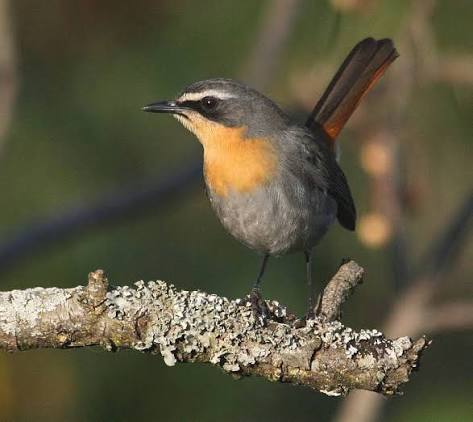
Rüppell’s robin chat is a highland forest species found in Ethiopia, Kenya, Uganda, and Tanzania’s highland zones. It shows a blue-grey head with a white supercilium, an orange breast, and dark upperparts. The species inhabits highland forest undergrowth above approximately 1,500 metres altitude.
In Kenya, the species is common in the highland forests of Mount Kenya and the Aberdare Mountains. In Uganda, it occurs in the highland forest zones of Bwindi and the Rwenzori foothills. The highland habitat requirement means it is encountered on mountain circuit itineraries that access forest above the lowland savanna zone.
Where to See Robin Chats in East Africa
White-browed robin chats are common across East Africa’s forest and garden habitats and require no specialist access or timing. The species visits the grounds of virtually every forest and woodland lodge in Uganda, Kenya, and Tanzania and appears regularly in outdoor dining areas and garden paths throughout the region.
Red-capped robin chats require coastal forest or highland forest destinations for reliable sightings. Kenya’s Arabuko Sokoke coastal forest, Uganda’s Kibale Forest, and Tanzania’s Amani Nature Reserve all produce regular red-capped robin chat encounters on guided forest walks.
Uganda’s Bwindi Forest and Kibale National Park provide simultaneous access to multiple robin chat species within the same forested environment, making these sites particularly productive for observers targeting the full East African robin chat community.
Plan Your Birding Safari
Robin chat encounters are achievable on any East Africa safari that includes forest or woodland destinations. The white-browed robin chat is a camp garden regular at most lodges across the region. Forest destinations provide the additional species that the white-browed cannot supply.
Morning garden birding before the game drive departs consistently produces white-browed robin chat sightings at most forest-adjacent camps. The species is comfortable around humans in low-disturbance environments and approaches within 2 to 3 metres of quiet observers in garden settings.
African Wild Trekkers designs East Africa safari itineraries with forest and garden destinations where the full robin chat diversity of the region is accessible. Contact us to plan a safari that captures East Africa’s most melodious song-birds in the best forest and woodland environments.