Great Blue Turaco: Africa’s Largest and Most Spectacular Turaco
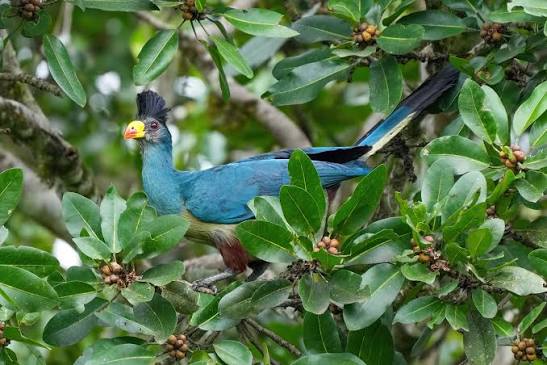
The great blue turaco is the largest member of the turaco family and one of the most visually impressive birds in East Africa. It measures 70 to 76 centimetres from bill tip to tail, making it considerably larger than any other turaco species. The plumage is a combination of turquoise-blue, green, and yellow that is unique among African birds and immediately identifiable even at canopy height.
The species is a bird of the Congo Basin forest and its eastern extensions into Uganda and western Kenya. In East Africa, it reaches the eastern limit of its range in Kakamega Forest in Kenya and extends across Uganda’s western forest zone into the highlands bordering Rwanda and DRC. Finding this species is a primary birding objective for many visitors to Uganda and western Kenya.
Identification and Plumage
The great blue turaco’s size alone distinguishes it from all other turacos within its range. The upperparts are deep turquoise-blue. The breast and belly show yellow-green. The wings, when spread in flight, reveal a rich chestnut-red underwing patch that is startling in its contrast with the blue upperpart colour.
The bill is yellow with a red tip. A black band borders the bill from the base, and a blue crest stands erect on the crown. The eye is surrounded by bare red skin that is visible at close range. The overall impression is of a bird more suited to a tropical butterfly collection than to a forest canopy, yet it sits naturally in the tall trees of the Congo Basin and its eastern extensions.
The flight is heavy and flapping, interspersed with glides. The bird moves between trees with deliberate, laboured wingbeats that show the full colour pattern as it crosses open gaps between the canopy. The large size makes it visible from considerable distance even in dense forest when it moves between positions.
Habits and Diet
Great blue turacos are frugivores. They feed primarily on fruit, buds, and leaves in the forest canopy. Their large size allows them to access fruits and perch positions unavailable to smaller frugivores. They move through the canopy in pairs or small family groups of 3 to 6 birds.
The call is a series of deep, resonant, cooing notes delivered slowly and with a deliberate rhythm. The call carries well through the forest. It helps locate birds that are otherwise hidden in the canopy cover. Groups coordinate their movements through regular calling between individuals.
The species is sedentary within a home territory. Individuals and pairs return to the same fruiting trees repeatedly when those trees are producing. A guide who knows the fruiting schedule of the forest’s key trees can position a birding group at the most productive observation point on any given morning.
Where to See Great Blue Turacos
Uganda provides East Africa’s most reliable great blue turaco sightings. Bwindi Impenetrable Forest, Kibale National Park, and the forests of Semuliki National Park on the Albertine Rift all hold resident populations. The species is regularly encountered on chimp trekking routes in Kibale and on gorilla trekking approaches in Bwindi.
Kenya’s Kakamega Forest carries great blue turacos at the extreme eastern limit of their range. Sightings at Kakamega are considered particularly significant as they represent one of the few places in Kenya where this Congo Basin species can be reliably found.
Additionally, Rwanda’s Nyungwe Forest holds great blue turacos in its highland sections. The suspended canopy walkway at Nyungwe provides an elevated viewing platform where great blue turacos sometimes pass at eye level or just below during their canopy movements between feeding areas.
Plan Your Birding Safari
Great blue turaco sightings require visiting Uganda’s western forest destinations, Rwanda’s Nyungwe, or Kenya’s Kakamega. Each of these destinations carries additional forest bird specialties that make the trip worthwhile beyond the turaco target alone.
Uganda’s Kibale Forest provides the most accessible combination of great blue turaco sightings with chimpanzee trekking and a rich array of Albertine Rift endemic bird species within a single park visit.
African Wild Trekkers builds Uganda and Kenya forest birding itineraries with great blue turaco as a primary target species. Contact us to plan a birding safari that explores East Africa’s most spectacular forest bird communities.