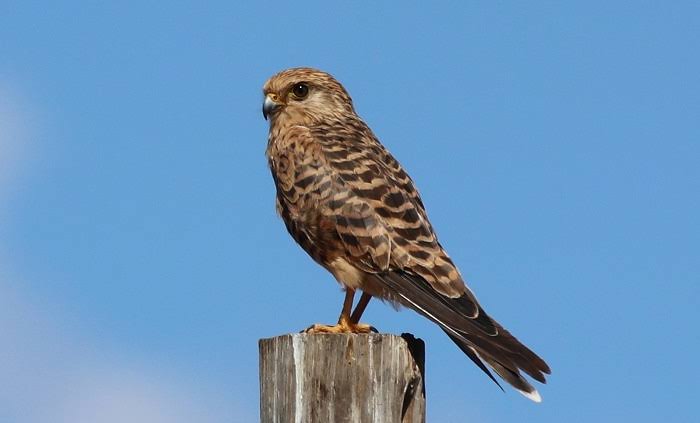
Greater Kestrel Africa: The Pale Hunter of East Africa’s Open Dry Plains
The greater kestrel is the largest kestrel species in Africa and the one most strongly associated with dry, open grassland and semi-arid savanna habitats. Its pale, lightly spotted plumage provides effective camouflage against the dry grass and pale soil of its preferred habitat. The species is widely distributed across the drier areas of East, Central, and South Africa and is the dominant kestrel species in the arid grassland zones that the rock kestrel’s cliff habitat preference cannot satisfy.
The greater kestrel is distinguished from other kestrel species by its pale overall colouration and its white eye — an unusual feature in a raptor and one that gives the species a distinctive appearance in the field that separates it immediately from all other East African kestrels once the white eye is noted.
Identification
The greater kestrel measures 34 to 36 centimetres, making it noticeably larger than the rock kestrel. The plumage is rufous-brown above with dark spotting. The underparts are whitish to pale buff with dark brown streaking. The head is pale rufous-brown with dark streaking, without the grey head of the male rock kestrel. Both sexes are similar in plumage, unlike the rock kestrel in which the sexes show different head colour.
The white eye is the most immediately useful identification feature in the field. Most raptors show yellow, brown, or dark eye colour. The greater kestrel’s whitish-grey iris is visible at close range as a pale circle within the dark-rimmed facial structure. Once noted, this feature is immediately recognisable and distinguishes the species from all other kestrels and similar-sized raptors in East Africa.
The tail is barred with a dark terminal band. In soaring flight, the pale underparts and the spotted rufous upperparts create a patterned appearance quite different from the relatively uniform pale underside of the rock kestrel in flight. The wing tips in direct flight show pointed falcon shape typical of the kestrel group.
Hunting and Behaviour
The greater kestrel hunts from hovering flight and from prominent perches including fence posts, termite mounds, and isolated trees in open grassland. The hover is used more extensively over open ground where updrafts are less reliable than the cliff face updrafts that the rock kestrel exploits. The larger body of the greater kestrel provides the wing area needed for sustained hovering in still air conditions over flat terrain.
The diet consists primarily of large insects, particularly grasshoppers and beetles. Small lizards, mice, and small snakes are also taken when encountered. The species is most productive as a hunter during the morning hours when insects are most active in the open grassland before the midday heat drives them into the shade of the grass bases.
Furthermore, the greater kestrel is attracted to areas of recently burned grassland and dry season concentrations of termite mounds where insect prey densities are temporarily elevated. A greater kestrel hunting over a burned grassland area during the dry season is one of the most accessible raptor hunting spectacles in East Africa’s open country.
Where to See Greater Kestrels in East Africa
The greater kestrel is most reliably found in East Africa’s drier grassland and semi-arid zones. Tanzania’s Maasai steppe south of Tarangire, Kenya’s Tsavo East open plains, and the arid areas of Uganda’s Kidepo Valley all provide habitat suitable for greater kestrel populations.
The species is most commonly encountered perched on roadside fence posts and isolated trees in open grassland areas. Any drive through the dry grassland sections of northern Tanzania or eastern Kenya during the dry season passes greater kestrel perch sites at regular intervals along the route.
Kenya’s Amboseli National Park and the open dry grasslands between Amboseli and Tsavo carry greater kestrel populations in the flat, arid terrain that this species prefers. The open sightlines of the Amboseli basin make individual kestrels visible from moving vehicles at distances that would make them invisible in denser vegetation types.
Plan Your Birding Safari
Greater kestrel sightings are most reliable in East Africa’s dry grassland destinations during the dry season when the short grass and reduced vegetation height make ground-hunting raptors most visible. Tanzania’s Tarangire-Maasai steppe circuit and Kenya’s Tsavo provide the most productive environments within the main safari circuit.
The white eye that identifies the species is visible through binoculars when the kestrel perches on a fence post or termite mound beside the road. A brief vehicle stop to assess a perched kestrel’s eye colour is the most efficient field identification technique for separating the greater kestrel from the similar rock and lesser kestrels.
African Wild Trekkers includes dry savanna and semi-arid destinations in East Africa birding safari itineraries targeting the full range of the region’s kestrel and falcon species. Contact us to plan a safari that covers East Africa’s raptor diversity across the full range of the region’s habitat types.