Olive Baboon Africa: The Most Widespread Primate of East Africa’s Savanna
The olive baboon is the most commonly encountered primate on East Africa game drives. Its troop occupies the roadside, the waterhole margin, the lodge garden, and the acacia woodland with equal confidence. Familiarity breeds inattention most safari visitors acknowledge olive baboons and move on. This is a mistake. Baboon troops are among the most behaviourally complex societies in the animal kingdom, and a 30-minute observation of a large troop produces more social interactions than most other wildlife encounters can offer in a full day.
What Is an Olive Baboon?
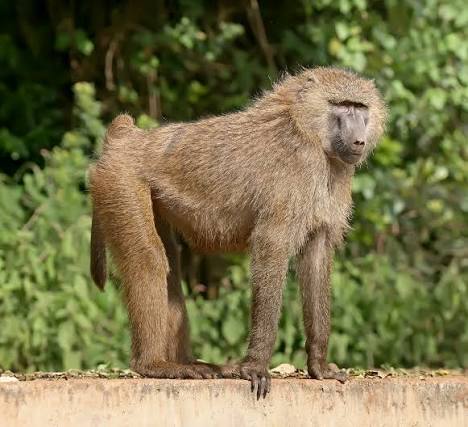
The olive baboon, Papio anubis, is the largest baboon species and the most widespread in sub-Saharan Africa. Adult males weigh between 22 and 37 kilograms. Females weigh 11 to 15 kilograms. Male shoulder height reaches approximately 70 centimetres when walking on all fours. The coat is olive-green to brown-grey the colour that names the species. Males carry a distinctive heavy mane around the head and shoulders. Both sexes carry the characteristic dog-like elongated muzzle, pale eyelids, and bare pink-red face skin of the baboon family.
Sexual dimorphism is pronounced. Adult males are roughly twice the size of adult females. Males carry large canine teeth reaching 5 centimetres weapons used in male-male combat and in defence against predators. The size difference between sexes is among the most pronounced of any primate.
Troop Structure and Social Hierarchy
Olive baboon troops contain 15 to 150 individuals a multi-male, multi-female social group with a complex internal hierarchy. Males rank among themselves through a combination of size, fighting ability, coalition formation, and coalition maintenance. A male’s rank determines his access to food resources and to receptive females. Top-ranking males do not simply fight their way to the top and hold position by force — maintaining rank requires constant alliance management with other males and with female allies.
Female rank is inherited matrilineally and is more stable than male rank over time. A high-ranking female’s daughters rank below her and above the daughters of lower-ranking females. Female rank determines food access, grooming partnerships, and support in aggressive interactions. The most enduring social bonds in a troop are between females of the same matriline mothers, daughters, and sisters that groom, travel, and defend each other throughout their lives.
Grooming: The Social Currency
Grooming is the primary currency of baboon social relationships. Individuals spend 15 to 20 percent of daylight hours grooming using fingers and lips to remove parasites, debris, and dead skin from the partner’s fur. This hygiene function is real but secondary to the social function. Grooming reinforces alliances, reduces tension after conflicts, solicits support in future aggressive interactions, and signals relationship quality between individuals. Who grooms whom, for how long, and in what context encodes the full complexity of troop social relationships in observable behaviour.
Omnivore and Predator Defence
Olive baboons eat grass, roots, seeds, fruit, invertebrates, small mammals, and occasionally larger prey including young antelope and hares. Large troops collectively monitor for predators the alarm bark of one individual silences the troop and produces immediate scanning behaviour in all members. Adult males mob terrestrial predators. Several males working together can drive off a cheetah or a single leopard and have killed both species in documented East Africa encounters.
Plan Your Safari
Olive baboon troops appear in virtually every East Africa national park and conservancy with savanna and woodland habitat. The Maasai Mara, Amboseli, and Samburu produce large, well-habituated troops that allow sustained close observation. Uganda’s Kibale Forest and Queen Elizabeth produce forest-edge troop encounters alongside chimps, red-tailed monkeys, and other primates. Stopping a vehicle beside a resting troop and watching quietly for 30 minutes produces more behavioural observation than any drive-past can.
African Wild Trekkers designs East Africa safari itineraries that include dedicated wildlife observation time beyond the large mammals. Contact us to plan a safari that explores the full complexity of East Africa’s extraordinary primate communities.