Wildebeest Population in 2026: The Current Picture
How Many Wildebeest Cross into Kenya Each Year
Current Population Estimates for the Serengeti-Mara Ecosystem
The wildebeest population in the Serengeti-Mara ecosystem—the single connected wildlife system spanning northern Tanzania and southwest Kenya—sits at approximately 1.3 to 1.5 million animals, according to the most recent aerial census data. This population fluctuates from year to year based on rainfall, disease events, and poaching pressure but has remained relatively stable through the early 2020s after recovering from declines in the 1990s and early 2000s. The 2026 estimate places the population at the higher end of recent counts, reflecting several consecutive years of adequate rainfall in the ecosystem’s core calving and grazing zones.
This is the herd that collectively forms the spectacle known as the Great Migration. Not all of these 1.3 to 1.5 million animals cross into Kenya every year. The northern migration into the Maasai Mara depends on grass availability in Tanzania’s Serengeti and the relative condition of the Mara’s grazing. The 2026 season follows a pattern of moderate rainfall that wildlife managers expect will push the majority of the herd into Kenya by late July.
What Determines How Many Animals Reach Kenya
Rainfall timing in the southern Serengeti determines when wildebeest begin their northward movement and how many animals ultimately reach the Maasai Mara. The herd follows new grass growth in a clockwise circuit through the ecosystem—calving on the short-grass plains of the southern Serengeti between January and March, moving northwest through the corridor during May and June, and pushing north into Kenya’s Mara between July and October before the short rains push them south again. A late rainy season in Tanzania delays the northward movement and compresses the Kenya window. An early dry season in the south accelerates the migration and extends the time wildebeest spend in Kenya’s reserves.
In years when the Serengeti receives good late-season rains, a portion of the herd remains in Tanzania longer, and fewer animals push north across the Mara River. In dry years, the Mara’s green grass draws the entire herd northward with more urgency, producing denser crossings and more dramatic concentrations along the Kenyan side of the ecosystem. Predation, disease, and river crossings reduce the population by hundreds of thousands of animals each year through the migration cycle. These losses are offset by the calving season’s enormous productivity — the herd produces roughly 500,000 calves between January and March each year, replacing losses and maintaining the population at its current level.
When and Where to See the Wildebeest in Kenya
River Crossings: The Most Dramatic Scenes
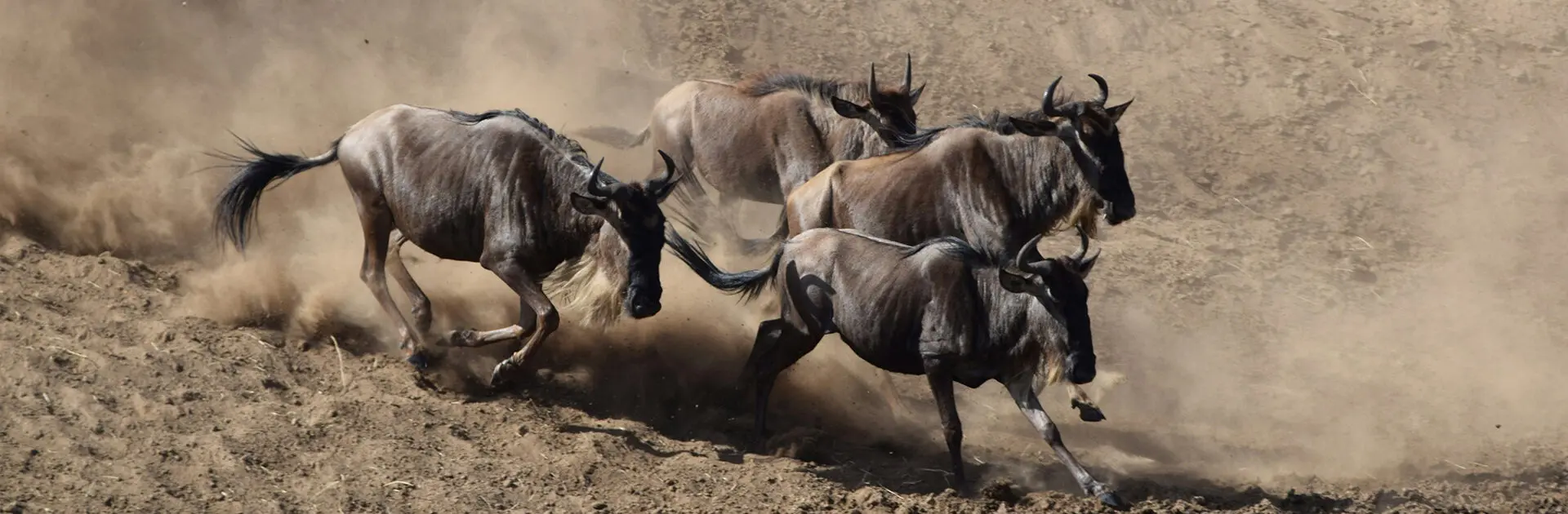
The Mara River crossings between July and October produce the migration’s most photographed and most anticipated moments. Hundreds or thousands of wildebeest launch themselves into a crocodile-filled river in a wave of panic and determination that overtakes individual hesitation. A crossing begins when a lead animal reaches the river’s edge and pauses—sometimes for minutes, sometimes for hours—before the pressure of the herd behind forces it into the water. Once the first animal jumps, thousands follow within seconds in a churning cascade of hooves, dust, and sound.
The Mara Triangle sector of the reserve along the river’s western bank concentrates the most reliable crossing points because the terrain funnels wildebeest toward specific entry and exit locations that guides know by observation and experience. Governors’ Camp and Mara Intrepids Camp position guests for morning drives to these locations. The Triangle’s management limits the number of vehicles at any single crossing to reduce disturbance and maintain the quality of the experience. Guides who monitor radio networks and drone data know when a crossing is imminent and can position vehicles 30 minutes before the first animal enters the water — the difference between seeing the full event and arriving during the aftermath.
Before and After the Crossing Season
The Mara’s wildebeest season extends beyond the crossing spectacle to include the pre-crossing build-up in late June and early July, when herds assemble in Tanzania’s northern Serengeti before pushing across the border into Kenya. This period produces vast panoramic views of moving herds across open savanna that offer a different kind of wildlife photography from the intimate chaos of a river crossing. Wide-angle images of thousands of animals stretching to the horizon create a sense of scale that telephoto lenses cannot capture.
October brings the migration’s departure from Kenya as the short rains begin to green the southern Serengeti and the herd reverses direction. This southward movement produces crossings in the opposite direction at the same Mara River points. It receives fewer visitors than the northward push, creating an opportunity for quiet, uncrowded game drives with high wildlife density and minimal vehicle competition. November in the Mara delivers excellent predator activity as the resident cats follow the departing herds. The conservancies are empty of peak-season visitors, producing some of the year’s most relaxed safari conditions.
Migration Viewing Beyond the River
The migration’s presence in Kenya extends across the entire Mara ecosystem during peak season rather than concentrating only at river crossing points. Some of the most memorable wildlife moments occur across open plains far from the water. A single cheetah hunting among a scattered herd of ten thousand wildebeest demonstrates natural selection in real time—the cheetah targets one animal from the herd, isolates it through acceleration, and either succeeds or fails within seconds while the rest of the herd continues grazing indifferently.
These hunts occur throughout the Mara during migration season. The migration also draws Kenya’s largest concentrations of raptors—tawny eagles, martial eagles, and bateleur eagles circle thermals above the herds and descend on carcasses within minutes of a predator’s making a kill. White-backed vultures strip a wildebeest carcass to bones within 20 minutes, a feeding frenzy that guides time drives around for guests who want to witness the full cycle of predation and scavenging that keeps the ecosystem functioning.
Conservation and the Future of the Migration
Threats and Protection of the Wildebeest Population
Current Threats to Wildebeest Numbers
Agricultural expansion along the Mara ecosystem’s boundaries represents the single largest long-term threat to the wildebeest migration’s continuity in Kenya. As Maasai landowners convert traditional grazing land to wheat farming — particularly in the Loita Hills and Transmara regions north and west of the reserve — the seasonal dispersal areas that wildebeest use outside the formal park boundaries shrink. A 2020 study published in Science found that the area available to wildlife outside Kenya’s protected areas declined by 70 percent over four decades, with the Mara ecosystem among the most severely affected. Without these dispersal areas, wildebeest concentrate in the national reserve at densities that degrade habitat faster than it recovers.
Illegal snare poaching takes a toll that removes tens of thousands of wildebeest and zebra from the ecosystem each year. Anti-poaching operations by the Mara Conservancy, Kenya Wildlife Service, and private conservancy rangers have reduced snaring significantly within the formal reserve boundaries. Tourism revenue that flows directly to Maasai landowners through conservancy agreements provides an economic incentive to tolerate wildlife on private land and represents the most effective long-term tool for maintaining the migration’s geographic range.
Why the Migration Remains Healthy in 2026
The Serengeti-Mara ecosystem’s wildebeest population remains at historically healthy levels in 2026 partly because of the Serengeti’s enormous size—at 14,763 square kilometers, it provides a core refuge that human activity cannot easily compromise. The Tanzanian government’s strong commitment to the Serengeti as a national asset has prevented the agricultural encroachment threatening Kenya’s side of the border. The core herd’s calving grounds in the southern Serengeti remain largely undisturbed. This core population stability means that even if Kenya’s Mara corridor degrades further, the migration cycle continues from Tanzania’s end as long as the southern plains retain their ecological integrity.
Private conservancy expansion in Kenya’s Mara over the past decade has added hundreds of thousands of acres of protected wildlife habitat immediately adjacent to the national reserve, reversing some of the habitat loss from earlier agricultural conversion. Conservancies like Ol Kinyei, Naboisho, and Mara North now protect land critical to the migration’s northern Kenya leg. Revenue from tourism camps on these conservancies funds ranger salaries, community development, and land lease payments to Maasai families that make conservation economically competitive with farming — a model cited internationally as one of the most successful in Africa.
Plan Your Safari
The wildebeest migration calendar shifts each year depending on rainfall and current grass conditions in both Tanzania and Kenya, and the best crossing dates in any given season are only accurately known four to six weeks in advance. Booking camps for a flexible window around peak crossing season rather than a fixed week reduces the risk of arriving before or after the herds concentrate at the river. African Wild Trekkers monitors conditions through guide networks on the ground and advises guests on the best timing adjustments before travel dates are finalized.
The package covers accommodation in camps positioned close to key crossing points, morning and afternoon game drives with experienced migration guides, park fees, conservancy levies, and airstrip transfers. Camps are selected for their proximity to the Mara River and their guides’ track record with crossing predictions so that no drive day is wasted travelling across the ecosystem to find the herds.
Contact African Wild Trekkers at africanwildtrekkers.com/contact with your migration season dates, and we will confirm camp availability and current herd position information within 24 hours.