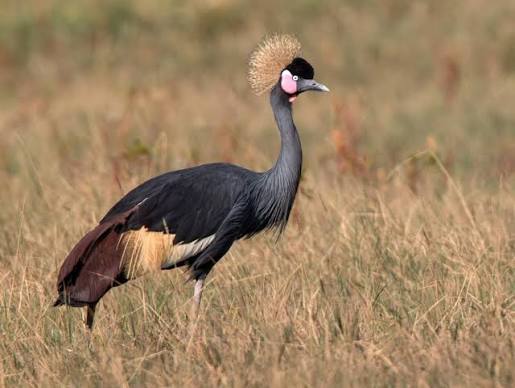
Black Crowned Crane: Africa’s Western Counterpart to the Grey Crowned Crane
The black crowned crane is the western sibling species to the grey crowned crane of East Africa. The two species are so similar in overall appearance that they were historically treated as subspecies of a single species. Today they are recognised as full species based on their distinct ranges, subtle plumage differences, and the limited overlap between their populations in the region where their ranges meet.
The black crowned crane inhabits the Sahel zone and the West and Central African grassland and wetland belt, extending eastward into parts of northern Uganda and South Sudan at the edge of its range. In East Africa, it is a much less common bird than the grey crowned crane and is considered a speciality sighting in the northern parts of Uganda where both species occasionally occur.
Identification and Differences From Grey Crowned Crane
The black crowned crane shares the spectacular golden crown of bristle-like feathers with the grey crowned crane. The crown is slightly less elaborate in the black crowned crane, with fewer and slightly shorter bristles. The face shows red and white cheek patches similar to the grey crowned crane but the proportions differ slightly between species.
The most reliable plumage difference between the two species is the extent of red on the face. The black crowned crane shows a larger area of red on the cheek relative to the white area compared to the grey crowned crane. The throat wattle is also proportionally larger and redder in the black crowned crane.
The body plumage of the black crowned crane is darker grey overall. The wing pattern shows white and chestnut colouring similar to the grey crowned crane but with subtle differences in the exact arrangement and extent of each colour. In direct comparison, the two species are clearly different. In isolation, separating a lone individual of either species requires careful attention to these facial and body plumage details.
Range and Habitat
The black crowned crane’s primary range covers West Africa from Senegal to Nigeria and extends through the Sahel grassland belt eastward into Chad, Sudan, and the northern parts of Central Africa. The species inhabits flooded grassland, wetland margins, and the open savanna zones of the Sahel where seasonal flooding creates the shallow marsh habitat the species prefers for nesting and feeding.
The range of the black crowned crane meets the range of the grey crowned crane in a broad contact zone through South Sudan and northern Uganda. In this overlap zone, both species occur and occasional hybrid individuals have been recorded. These hybrids show intermediate characteristics between the two parent species and are of significant interest to researchers studying the divergence and relationship between the two crane species.
Conservation Status
Both crowned crane species are classified as Vulnerable on the IUCN Red List. The black crowned crane faces the additional pressure of very significant capture for the caged bird trade in West Africa, where the species is highly valued as a decorative bird for private collections and public spaces.
Wetland drainage and habitat conversion across the Sahel zone removes the nesting and feeding habitat that the species requires. Climate change-driven changes in rainfall patterns in the Sahel have altered the seasonal flooding patterns that maintain the temporary wetlands the species depends on for breeding in the drier parts of its range.
Furthermore, the combination of trapping for trade, habitat loss, and climate-related habitat change creates a compound pressure on the black crowned crane that conservation programmes across West Africa are working to address. Eco-tourism that generates revenue for wetland protection contributes to the economic case for maintaining the habitats both crane species require.
Plan Your Birding Safari
Black crowned crane sightings in East Africa require the northernmost Uganda destinations. Uganda’s Kidepo Valley National Park is the most accessible location for potential contact zone encounters. The park’s remote northern location and the adjacent South Sudan border zone represent the eastern limit of the black crowned crane’s core range.
For birders who want to see both crowned crane species on the same itinerary, Uganda provides the unique opportunity within East Africa. Grey crowned cranes are common throughout the country. Black crowned cranes require the additional Kidepo component at the northern extreme of the itinerary.
African Wild Trekkers includes Uganda’s Kidepo Valley National Park in specialist birding safari itineraries for guests targeting the full diversity of Uganda’s avifauna. Contact us to plan a northern Uganda birding safari that combines crane watching with Kidepo’s extraordinary dry-zone bird community.