Oribi Antelope Facts: The Small Grassland Specialist of East Africa
The oribi occupies a grassland niche that most small antelopes avoid the tall, dense grass zone of montane and moist savanna. Where dik-diks prefer dry acacia scrub and klipspringers inhabit rock, the oribi lives in the tall grass that floods and grows back green after fire. It is a grassland specialist in the truest sense, and its survival is bound to the maintenance of the grass communities that most safari visitors drive through without stopping.
What Is an Oribi?
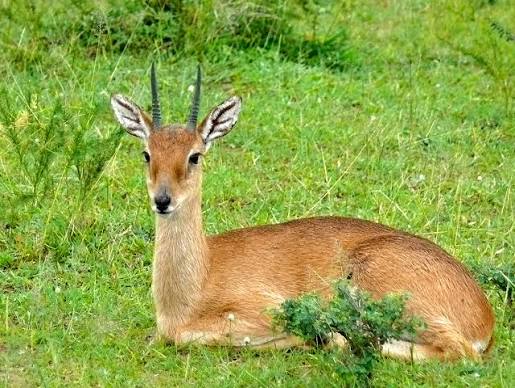
The oribi, Ourebia ourebi, is a small antelope of the bovid family. An adult weighs between 12 and 22 kilograms. Body length reaches 92 to 110 centimetres. The coat is sandy-rufous above with white underparts and a distinctive white patch on each side of the nose. The tail is short with a black tip. A bare, dark pre-orbital gland patch marks the face below and in front of each eye. Only males carry horns short, straight, and ringed, reaching 8 to 19 centimetres.
The ears are large and rounded. When alarmed, the oribi holds the ears erect and swivels them toward the threat source. Its eyesight is good and its hearing exceptional for detecting predators in tall grass where visual detection is limited.
The Pronk: Stiff-Legged Alarm Leap
The oribi’s alarm response includes pronking stiff-legged vertical leaps in which all four feet leave the ground simultaneously. The pronk elevates the animal above the level of tall grass, giving it a brief view of the approaching threat. It also signals to conspecifics that a predator has been detected. The pronk’s conspicuousness means it cannot be a purely anti-predator concealment behaviour it communicates alarm to other oribi within the grass before the flight response commits the individual to a specific direction.
The running flight from an alarmed pronk involves a sharp alarm whistle and a stiff-legged bounding that covers ground quickly while remaining visible above grass level for the first few bounds. The animal then drops into the grass and runs low, using the grass as concealment cover for the actual escape direction.
Habitat: Fire and Grassland Management
Oribi are closely associated with grassland management by fire. They prefer the early regrowth stage after a grass fire the new green shoots that emerge within days of a burn. Areas that have not burned for two or more years carry grass too dense and tall for oribi to use effectively.
This fire dependency links oribi conservation to grassland management policy. Parks that suppress all fire lose oribi populations within years. Parks with active burning programmes Queen Elizabeth in Uganda, parts of the Maasai Mara ecosystem, and Uganda’s Kidepo Valley maintain healthy oribi populations in their fire-managed grassland zones.
Range in East Africa
Oribi occur across East Africa’s moist grassland zones but are nowhere abundant. Uganda’s Queen Elizabeth National Park, Kidepo Valley, and Murchison Falls hold the most significant Uganda populations. Kenya’s Masai Mara’s Mara North Conservancy grasslands and parts of the Laikipia Plateau hold populations that are declining due to grassland modification. Rwanda’s Akagera National Park holds a small population in its open grassland zones.
Plan Your Safari
Oribi are never a guaranteed sighting but are a memorable one when found. Uganda’s Kidepo Valley National Park and Queen Elizabeth’s Kasenyi plain are the most reliable sites in East Africa. Early morning drives through recently burned grassland give the best chance oribi concentrate on regrowth areas in the days after a fire. A slow drive through open short grass with occasional stops to glass the terrain with binoculars is the effective search strategy.
African Wild Trekkers includes Uganda’s grassland parks Kidepo and Queen Elizabeth in specialist East Africa itineraries. Contact us to design a safari that captures the full range of East Africa’s grassland wildlife.